
What a UK Welcome Bonus Actually Costs in 2026
A welcome bonus is the one part of a casino’s pitch that talks about giving the player something. The honest read is that it talks about giving the player a structured set of conditions, and the value depends on what sits at the end of those conditions. Across the UK market, that end changed on 19 December 2025, when the Gambling Commission capped wagering requirements on deposit bonuses at 10x — a sharp tightening from the multiples that ran before. The page below is built around that shift. It compares the ten operators a UK player is most likely to meet on the Commission’s own register, walks through what a bonus genuinely takes to clear, and lands the reader on a verdict they can act on.

Current as of 7 November 2026 against the Gambling Commission’s public register of gambling businesses.
- What a Welcome Bonus Is, and Why the Terms Matter
- The Landscape in 2026
- Why a Licensed Casino Is the Only Casino Worth Comparing
- Safer-Gambling Checks Around Any Welcome Offer
- Funding the Bonus: Payment Methods and Speed
- How Long It Takes to Clear a 10x Wagering Bonus
- The Ten Operators on the Register
- How to Pick a Welcome Bonus Without Being Picked
- Frequently Asked Questions
What a Welcome Bonus Is, and Why the Terms Matter
A welcome bonus is money or spins the casino credits to a new account. The structure is almost always the same: a deposit match, a fixed bonus amount, free spins on a named slot, or some combination. What separates a generous offer from a punishing one is what the casino asks back.
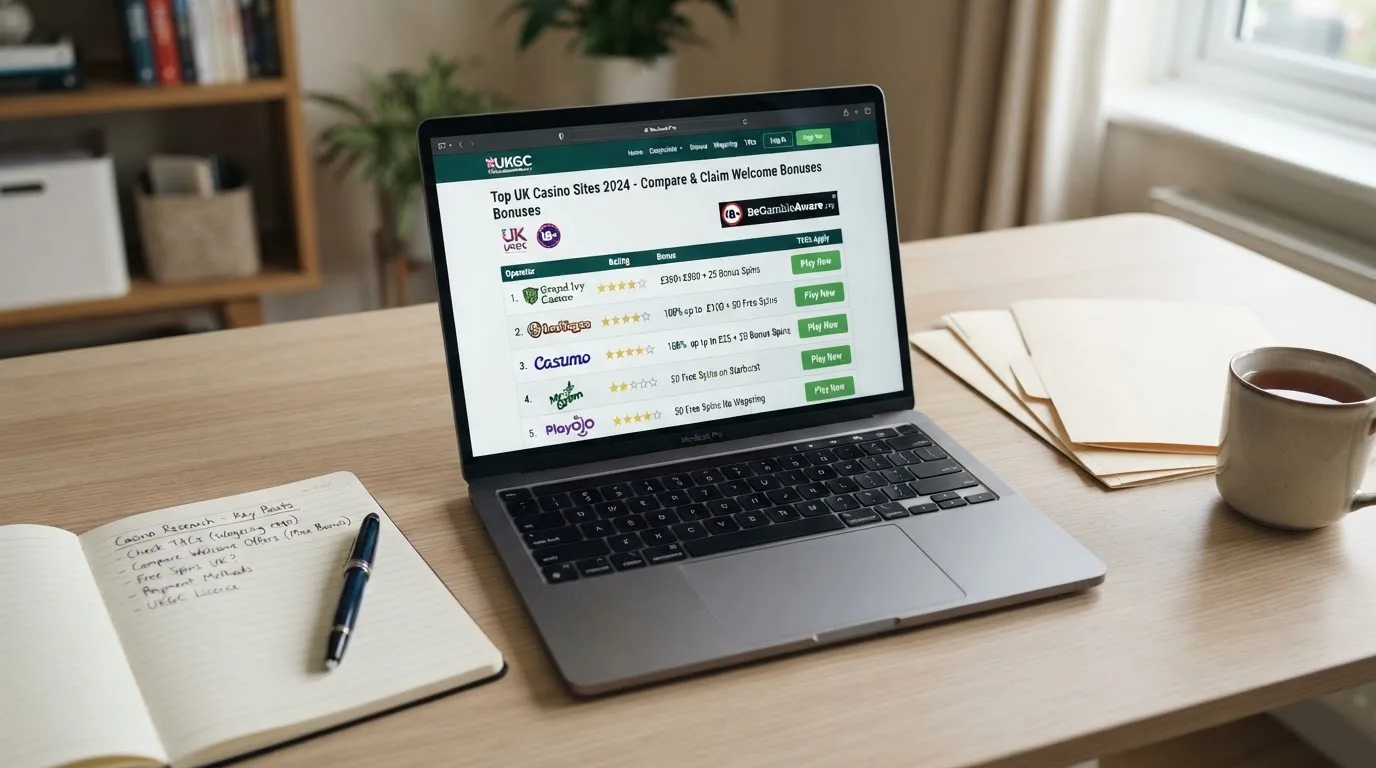
The headline figure tells you almost nothing. A “100% up to £200” sounds substantial. So does “200% up to £100”. What decides the real worth is the wagering requirement: how many times the bonus has to be turned over before it can be withdrawn. Two bonuses with identical headlining can cost the player entirely different amounts in lost money, depending on that single number.
The wagering requirement is also where the law now intervenes. Since 19 December 2025, the Gambling Commission has capped the wagering requirement on any deposit bonus at 10x the bonus amount. Anything above that is no longer on offer at any GB-licensed site. This is the single biggest change to UK welcome offers in years, and it is why a £25 bonus at 10x costs the player less than the £50 at 35x bonuses that older comparison guides still rank by.
The other mechanism worth understanding is the game cycle — one full spin of a slot from wager to result. Every UK online slot is now throttled so that no spin resolves faster than 2.5 seconds, auto-play is banned, and losses dressed up as wins (a payout with a celebratory sound) are forbidden. These are not bonus terms. They are the way every slot behaves at a licensed site, and they govern how long any wagering requirement takes to clear in practice.
The Landscape in 2026
The UK online casino market is large and steady rather than growing. On 18 September 2026, the Gambling Commission’s public register listed 139 businesses holding an active remote casino operating licence. The same register’s domain list — the file that names every website each licensee runs — held 1,065 active entries and a further 361 white-label entries, the latter being sites that trade under another company’s licence rather than their own.

What that number tells a player is that the register is the whole test of whether a brand is licensed. Any operator taking customers in Great Britain must hold a Commission licence under section 33 of the Gambling Act 2005, no matter where the company is actually based. A Curaçao or Malta licence on its own is not enough. The Commission’s public register is searchable online and downloadable in full as CSV or Excel, and a player can verify a brand’s status in minutes.
A remote casino licence number on the register follows a set pattern: account-R-number–suffix. The leading six digits repeat the licence holder’s account number, the R marks a remote (online) licence, and the suffix distinguishes individual licences under one account. The featured ten brands below are all on the active list, with the licence numbers the register assigns them.
Why a Licensed Casino Is the Only Casino Worth Comparing
The legal frame is what makes a UK welcome bonus comparison possible in the first place. Without a Gambling Commission licence, an operator is not allowed to take Great Britain customers — and the consequence is not a fine for the player. The player simply loses the protections a licence brings: no GAMSTOP, no Commission complaints route, no approved alternative dispute resolution.
GB-licensed sites must:
- Verify name, address and date of birth before the first deposit or any play — anonymous play is not possible.
- Enrol every customer in GAMSTOP, the national online self-exclusion scheme, with exclusion periods of six months, one year or five years, none cancellable early.
- Ban credit cards as a funding method. The ban took effect on 14 April 2020 and applies to credit cards routed through e-wallets as well.
- Run financial vulnerability checks. From 28 February 2025, a check is required once a customer reaches £150 net deposits in a rolling 30-day window, drawing on public data only.
- Prompt the customer to set a financial limit before the first deposit, a condition that took effect on 31 October 2025.
- Cap slot stakes by age: £5 per game cycle for players aged 25 and over (from 9 April 2025), £2 per game cycle for 18 to 24-year-olds (from 21 May 2025).
The maximum stake is set by game cycle, not by spin in the colloquial sense — it is one full sequence from wager to result. A player pressing spin twice on a £5 slot would need each press to be at or below £5 to stay within the rule.
The bonus side has tightened too. The 10x wagering cap on deposit bonuses from 19 December 2025 sits alongside a ban on mixed-product bonuses — offers that bundle a sports bet with casino spins, for example. A bonus must be paid in the product it is offered for. The credit card ban and the bonus cap together mark the sharpest tightening of the UK online casino offer in a decade.
Safer-Gambling Checks Around Any Welcome Offer
A welcome bonus is a marketing offer, not a financial one, and a player who treats it as the latter is the player the regulator is trying to protect. The safer-gambling checks that matter most are the ones the operator has to do — and the ones a player should do for themselves.
GAMSTOP is the headline tool. Every GB-licensed online casino checks GAMSTOP on registration and refuses to open an account for anyone on the register. The exclusion periods run six months, one year or five years. There is no early cancellation. A player who self-excludes is excluded across the whole market, not at one site.
Reality checks are mandatory on every slot session: a pop-up that tells the player how long they have been playing and how much they have won or lost. Time-outs of 24 hours, one week or any period up to six weeks can be set through the account. Beyond a time-out, GAMSTOP handles longer self-exclusion.
The financial vulnerability check at £150 net deposits in 30 days is light-touch: it draws on public data and is intended to flag people who may be in financial distress. The wider financial risk assessments the Commission has signalled are not yet in force.
For anyone whose gambling is becoming a worry, the National Gambling Helpline (run by GamCare) and GambleAware are the entry points. Both are free, both are confidential, and both are independent of any operator.
Funding the Bonus: Payment Methods and Speed
| Payment Method | Availability | Typical Speed |
|---|---|---|
| Debit cards | Universal | Instant |
| Bank transfers | Universal | Instant to 2 hours |
| Apple Pay | Widely accepted | Instant |
| AstroPay | Widely accepted | Instant |
Debit cards and bank transfers are universally accepted at GB-licensed sites. Bank transfers within the UK run through the Faster Payments Service, launched in 2008 and operated by Pay.UK. It runs 24 hours a day, seven days a week. Most payments arrive in seconds or a couple of minutes; transfers can occasionally take up to two hours. The Faster Payments scheme itself sets a £1,000,000 per-transaction ceiling, but most banks cap their own customers well below that.
Apple Pay is widely accepted at GB-licensed casinos. Apple Pay protects card data by tokenising it: the actual card number is replaced by a device-specific tokenised Device Primary Account Number, with a dynamic security code for each transaction. Apple Pay launched on 20 October 2014 with US cards only; UK-issued card support arrived on 14 July 2015. In-store, Apple Pay uses near-field communication (NFC) to talk to the contactless terminal. Online, authentication runs through the device’s biometric or passcode check. A supported card from a participating issuer is required — Apple Pay is not available everywhere.
AstroPay is an electronic-money option that operates globally. The UK entity, Larstal Limited, is authorised by the Financial Conduct Authority under the Electronic Money Regulations 2011. AstroPay was founded in 2009 and is headquartered in Uruguay; it offers online payments, virtual and physical debit cards, and peer-to-peer transfers. Its payment-processing arm, dLocal, was spun off as a separate company in 2016.
The credit card ban is the constraint that overrides everything else. From 14 April 2020, credit cards cannot be used to fund any gambling product in Great Britain, online or offline, including credit cards routed through e-wallets. Debit cards, bank transfers, and e-wallets funded from a debit card or bank account are unaffected. The Commission estimated that around 800,000 UK consumers used credit cards to gamble in 2018, and found that 22% of online gamblers who funded play with a credit card were classed as problem gamblers — the underlying evidence for the ban.
A no-deposit welcome bonus is the variant where the operator credits a small amount of bonus money or a handful of spins without requiring a deposit first. No-deposit offers are governed by the same 10x wagering cap as deposit bonuses and the same safer-gambling rules. They look like free money; they read as a structured set of conditions.
How Long It Takes to Clear a 10x Wagering Bonus
The arithmetic of clearing a welcome bonus is the most important calculation for the player. The fixed formula, with a 10x wagering cap in force since 19 December 2025, is:
required turnover = bonus amount × 10
A £100 bonus therefore requires £1,000 of wagering before withdrawal. A £25 bonus requires £250. The wagering requirement always sits on the bonus, never on the deposit, so the deposit itself is not part of the turnover calculation.
How that translates into time depends on the slot and the stake. At a £1 stake per spin, £1,000 of turnover is 1,000 spins. At a 2.5-second minimum interval between spins — the legal floor at every licensed site — 1,000 spins is 2,500 seconds, or roughly 42 minutes. At a £0.10 stake, the same turnover is 10,000 spins, or about 4 hours 10 minutes.
The stake the player chooses sets the time cost. A player who wants to clear the bonus quickly stakes at or near the £5 maximum (or £2 for under-25s). A player who wants to spend less per spin pays for that in time, not in turnover. The turnover requirement does not change.
The expected loss on a 96% RTP slot, assuming only the bonus amount is wagered, is £40 on a £1,000 turnover. That is the bonus’s real cost to the player, before any subsequent winnings are taken into account. The bonus is, on average, a £40 charge dressed up as a £100 gift.
The right way to read any welcome bonus, then, is to ask three questions: how much turnover the requirement demands, how many hours of slot play that represents at the stake the player intends to use, and what the expected loss on that turnover is at the slot’s RTP. Once those three numbers are on the table, the headlining falls away.
The Ten Operators on the Register
The brands below are ten of the licensed operators a UK player is most likely to meet. They are not ranked, and the order is not a recommendation. Each is taken from the Gambling Commission’s public register with the licence number the register assigns it. Several brands can share one licensee — Ladbrokes, Coral and Gala Bingo all sit under LC International Limited — and they are not independent operations even where the marketing separates them.
| Brand | Licence holder and GB remote casino licence | Domain status on the register | Welcome bonus subject support |
|---|---|---|---|
| Virgin Games | Gamesys Operations Limited (account 38905), licence 038905-R-319430-022 | White-label domain | — |
| Betfred | Petfre (Gibraltar) Limited (account 39544), licence 039544-R-319290-010 | Active domain | — |
| Betfair | PPB Games Limited (account 39411), licence 039411-R-319335-010 | Active domain | — |
| Sky Vegas | Bonne Terre Gaming Limited (account 65519), licence 065519-R-339675-002 | Active domain | — |
| Gala Bingo | LC International Limited (account 54743), licence 054743-R-330863-014 | Active domain | — |
| 32Red | Platinum Gaming Limited (account 45322), licence 045322-R-324275-019 | Active domain | — |
| Casumo | Recro Limited (account 61549), licence 061549-R-336718-002 | Active domain | — |
| Midnite | Dribble Media Limited (account 42647), licence 042647-R-321653-022 | Active domain | — |
| PokerStars | Stars Interactive Limited (account 39108), licence 039108-R-319334-026 | Active domain | — |
| Jackpotjoy | Gamesys Operations Limited (account 38905), licence 038905-R-319430-022 | Active domain | — |
The table above is the register rather than a ranking. Two columns repeat the same figure down every row — every brand holds a Commission licence, every one is on the active or white-label list — but the licence numbers differ, and the licence holder’s account is what links a brand to its parent company. Virgin Games and Jackpotjoy share a licence because they sit under the same operator; their welcome offers are not, on that account alone, separate products.
Virgin Games — A White-Label Licence Across Two Brands
Virgin Games sits on the register as a white-label domain of account 38905, Gamesys Operations Limited, the same licensee that runs Jackpotjoy. A white-label site trades under another company’s licence rather than its own, which is a structural detail rather than a mark against the brand — the licence conditions the operator must meet are identical.
For a player who likes the Virgin brand and wants a UK-regulated casino with a clear identity, Virgin Games is a sensible entry. For a player comparing welcome bonuses specifically, the better test is what the offer asks back, not which name sits on the homepage. The two sites below that share this licence will not necessarily run the same welcome offer.
Betfred — A Gibraltar-Headquartered Bookmaker at Home in the UK
Betfred’s licence is held by Petfre (Gibraltar) Limited, with the operating company based in Gibraltar but the licence issued by the Gambling Commission for Great Britain customers. The Commission’s regime applies in full: the credit card ban, the 10x wagering cap, GAMSTOP, the financial vulnerability check. The Gibraltar base is administrative, not legal.
For a player who already has a Betfred account for sports betting, the casino welcome offer is a familiar front door. For a casino-only player, the brand carries weight on the high street that does not always translate into a sharper casino offer than the dedicated casino brands.
Betfair — A Large Exchange Operator with a Casino on the Side
Betfair sits under PPB Games Limited, account 39411. The brand is better known for its betting exchange than for its casino, and the welcome offer reflects that balance. A player who values a casino bonus on its own terms may find more competitive offers at the dedicated casino brands; a player already using the exchange may find the casino welcome a useful second product.
Sky Vegas — A TV-Backed Brand with a Casino Focus
Sky Vegas is held by Bonne Terre Gaming Limited, account 65519. The brand is part of the Sky betting and gaming stable, with the casino as the lead product rather than a sideshow. For a player who already has Sky TV or a Sky Bet account, Sky Vegas is a natural pair. For a player choosing between casino brands, Sky Vegas’s licence status is unremarkable — what varies is the offer.
Gala Bingo — A Bingo Brand Under LC International
Gala Bingo sits under LC International Limited, account 54743, the same parent that runs Ladbrokes and Coral. The brand is a bingo-led operation; the casino welcome offer is real but secondary. A player looking for a casino welcome bonus specifically is, on this account, more likely to find a sharper offer at the brands whose casino is the lead product. A player who plays both bingo and casino may find the cross-product familiarity useful.
32Red — A Standalone Casino Brand
32Red is held by Platinum Gaming Limited, account 45322, and has been a casino-led operation for longer than most of the names on this list. The brand’s identity is built on the casino. For a player choosing on casino merit alone, 32Red is one of the more obvious candidates on this register. The licence is clean, the brand is dedicated, and the welcome offer is the lead product rather than an add-on.
Casumo — A Casino Brand with a Distinct Identity
Casumo is held by Recro Limited, account 61549. The brand has built its identity around a casino-first product with a distinctive user experience. For a player who wants a casino welcome bonus on a dedicated casino platform rather than a sportsbook extension, Casumo sits in the same bracket as 32Red. The licence is clean; the choice between them is a matter of preference.
Midnite — A Newer Casino Brand on the Register
Midnite is held by Dribble Media Limited, account 42647. Midnite is a newer entry than most of the names on this list. A newer brand is not a worse brand; the licence conditions are the same as for any GB-licensed operator. For a player who values a fresh casino product over an established one, Midnite is the natural candidate in this set.
PokerStars — A Poker Brand with a Casino Attached
PokerStars sits under Stars Interactive Limited, account 39108. The brand’s identity is built on poker; the casino is a secondary product. For a player whose primary interest is poker, the casino welcome offer is a useful second front. For a player choosing on casino merit alone, the brand is one of several on this register rather than a standout.
Jackpotjoy — Sharing a Licence with Virgin Games
Jackpotjoy is held by Gamesys Operations Limited, account 38905 — the same operator as Virgin Games. The two brands sit under the same licence and the same account; they are not independent operators even where the marketing separates them. For a player comparing the welcome offers of these two brands, the comparison should be made on the offer itself, not on the assumption that two names mean two companies.
How to Pick a Welcome Bonus Without Being Picked
A welcome bonus is a marketing offer, and the marketing is built around the headlining. The honest way to compare is on what the offer asks back, not what it offers first.
Three numbers tell the player everything they need:
- The wagering requirement. The legal cap is now 10x; any offer above that is not at a GB-licensed site.
- The time the wagering takes to clear at the stake the player intends to use. At £5 per spin and 2.5 seconds per spin, £1,000 of turnover takes about 42 minutes; at £0.10 per spin, the same turnover takes about four hours.
- The expected loss on that turnover. On a 96% RTP slot, £1,000 of turnover costs the player £40 in expectation.
Once those three numbers are on the table, the headlining falls away. A £25 bonus at 10x on a 96% slot is a £10 expected loss dressed up as £25 of value. A £100 bonus at 10x on the same slot is a £40 expected loss dressed up as £100. The arithmetic is the same in shape; the scale changes.
The conditions that are worth reading before claiming any offer are the ones the marketing does not surface: the maximum cashout (some no-deposit offers cap what can be withdrawn even after wagering), the game weighting (table games often contribute 10% or less of a slot’s stake toward wagering), the expiry (a bonus that expires in seven days is harder to clear than one that expires in thirty), and the payment-method restriction (some offers exclude deposits made through e-wallets).
Frequently Asked Questions
What’s the difference between a welcome bonus and a no-deposit welcome bonus?
A welcome bonus is credited once the player makes a qualifying deposit; a no-deposit welcome bonus is credited on registration, without a deposit. Both are governed by the same 10x wagering cap that took effect on 19 December 2025 and the same safer-gambling rules. A no-deposit offer is usually smaller and may carry a maximum cashout that limits what can be withdrawn.
How can a player check whether a casino is trustworthy?
The Gambling Commission’s public register is the whole test. It lists every business holding an active remote casino operating licence, along with the domains each one runs. A player can search the register by brand name or by licence number; the licence number follows the pattern account-R-number–suffix. Every GB-licensed online casino must also be enrolled in GAMSTOP and offer GamCare as a referral route.
What wagering requirement currently applies to UK welcome bonuses?
Since 19 December 2025, the Gambling Commission has capped wagering requirements on deposit bonuses at 10x the bonus amount. The cap applies to every GB-licensed operator. Mixed-product bonuses — offers that bundle a sports bet with casino spins, for example — are also banned. A no-deposit bonus is governed by the same 10x cap.
Does a welcome bonus expire if it is not used within a set time?
Yes, every welcome bonus carries an expiry, and the period varies by operator. Common windows are seven, fourteen or thirty days from the moment the bonus is credited. Any unplayed bonus and any winnings tied to unmet wagering are forfeit at expiry. The exact window is in the bonus terms; it is worth reading before claiming.
Can a welcome bonus be claimed on a mobile casino app as well as desktop?
Yes, at every GB-licensed operator. The bonus terms apply equally to mobile and desktop play; the wagering requirement, the eligible games and the expiry do not change by device. Some offers may be promoted through a specific channel but claimed on any device once the account is registered.
Is a welcome bonus only available to new customers?
Yes. A welcome bonus is, by definition, a once-per-customer offer, tied to the first deposit or first registration. One bonus per household, payment method and IP address is the usual restriction. The same player cannot claim a welcome bonus twice at the same operator even by opening a second account; the Commission’s verification rules make that very hard to do in practice.