
Paying by Phone Credit at a UK Mobile Casino: What It Costs, What It Catches
 Available in GB
Phone-credit deposits are the smallest route into a UK online casino. A £10 top-up takes a minute, lands in the cashier without a card number, and is settled against the next phone bill or trimmed from pay-as-you-go credit. The convenience is real, and so are the constraints. A £10 daily ceiling, a fee attached to most transactions, no withdrawal back to the same channel, and a casino that must still verify identity before a single spin pays out — those are the conditions a phone-billed deposit runs under at every site ranked below.
This ranking covers ten operators that hold a Gambling Commission remote casino licence and list a pay-by-phone-credit deposit method in their cashier. Every operator is verified against the Commission’s public register, the spreadsheet of licence holders and domains the Commission publishes and refreshes through the year. Data current as of 23 September 2026; checked against the Gambling Commission public register of gambling businesses.
- How Pay-by-Phone-Credit Deposits Actually Settle
- What the UK Licensing Frame Demands of a Casino
- Safer-Gambling Controls Around a Phone-Credit Deposit
- Deposit and Withdrawal Routing at a Phone-Credit Casino
- Ranking the Licensed Sites That Take Phone-Credit Deposits
- What a £10 Phone-Credit Bonus Actually Costs to Clear
- Reading the Register When a Site Is New
- Where the Limits Land in Real Play
- What an Offshore Site Would Cost the Player
- Final Word
- Frequently Asked Questions
How Pay-by-Phone-Credit Deposits Actually Settle
The flow looks different on the casino’s side and on the phone’s side, and the seam between them is where the rules bite.
The mechanism is direct carrier billing, an arrangement between the casino’s payment processor and the customer’s mobile network. The customer confirms the deposit with a one-tap SMS reply or an in-app prompt; the casino’s payment processor, usually Boku or Payforit, then bills the amount to the mobile account. The carrier settles with the processor, and the processor settles with the casino. None of this touches a bank card, which is precisely why the route exists for players who prefer not to share card details with a gambling site.
Two schemes dominate the UK market. Payforit grew out of work the SimPay consortium started in 2005 and launched commercially in 2007, and it remains the technical umbrella under which UK mobile network operators process these payments. Boku, the London-headquartered carrier-billing processor founded in 2009, sits on top of that infrastructure and routes the majority of casino deposits. The two are not interchangeable to a player; the daily ceiling, the per-transaction fee and the supported networks are set by the processor the casino has integrated.
The day-to-day regulation of premium-rate and phone-paid services in the UK moved from the Phone-paid Services Authority back to Ofcom from 1 February 2025, so the rules on disputed charges and premium-rate complaints now sit with the telecoms regulator rather than the specialist body that handled them before. That changes nothing about how a casino deposit flows; it changes who a customer complains to if the charge on the bill looks wrong.
Premium-rate UK telephone numbers carry a two-part charge structure that occasionally catches out users of older pay-by-phone methods: an access charge set by the caller’s phone company plus a service charge set by the receiving organisation, with the service charge capped between 7p per minute for 084x numbers and £3.60 per minute for 09xx numbers. The casino deposits handled by Boku and Payforit are billed as fixed amounts, not minute-rated calls, so this tariff table does not apply to them directly — but any casino that still uses a phone-call-back verification step falls inside it. Players who see an unexpected premium-rate line on their bill should treat the charge as a separate transaction and query it through their network’s premium-rate dispute route before contacting the casino.
What the UK Licensing Frame Demands of a Casino
Every site in this ranking holds a Gambling Commission remote casino operating licence. The Commission is sponsored by the Department for Culture, Media and Sport and acts under the Gambling Act 2005, which covers Great Britain — England, Scotland and Wales. Northern Ireland runs its own regime, and a UKGC licence does not authorise play from a Northern Irish address.

The Gambling (Licensing and Advertising) Act 2014 closed the loophole that let overseas operators serve British customers without a UK licence. A Curaçao, Malta or Gibraltar registration is not enough. Since 2014 any operator taking customers in Great Britain needs a Commission licence wherever it is incorporated, and the public register is the test of whether a brand holds one. A licence number on the register follows a fixed shape: six digits for the account number, the letter R for remote, a further sequence and a suffix. Reading 055149-R-331499-004, the leading 055149 points at the Hillside (UK Gaming) ENC account, R marks it as remote, and the trailing four-digit suffix identifies the specific licence within that account.
The Commission held 139 businesses with an active remote casino operating licence on 18 September 2026, and its separate domain list recorded 1,065 active and 361 white-label website entries on the same date. A white-label site trades under another company’s licence — Virgin Games, for instance, sits as a white-label domain of Gamesys Operations Limited, not as an independently licensed operator. Several consumer-facing brands can share a single licence account; Ladbrokes, Coral and Gala Bingo all sit under LC International Limited. The register does not rank them and does not assess them; it records who is licensed to operate, not whether they are any good.
Why the Licence Determines What the Player Sees
A UKGC licence is not a quality mark; it is a set of obligations. The conditions are written into the Licence Conditions and Codes of Practice (LCCP), the social responsibility code and the Remote Technical Standards, and they shape what an operator can offer, what it must block and what it has to ask before a player deposits.
Minimum age is 18, and identity verification has been mandatory before the first deposit or any play since 7 May 2019. The operator checks name, address and date of birth against public records and runs ongoing affordability monitoring once play begins. There is no anonymous-play loophole at a licensed site. A phone-credit deposit does not change this; the casino still has to verify the player holding the phone, and the deposit is held against the verified account or refused if verification fails.
The stake caps that came into force in 2025 bound the games themselves rather than the deposit. From 9 April 2025, players aged 25 and over have been limited to a maximum stake of £5 per game cycle on online slots; from 21 May 2025 that ceiling drops to £2 for 18-to-24-year-olds. A game cycle in the regulatory sense is one spin, so the limit applies to each individual button press rather than to a session. The cap is per-spin, not per-deposit.
Auto-play has been banned since 31 October 2021; a single spin may not resolve faster than 2.5 seconds, and the practice of running celebratory sounds and animations on a net loss — losses disguised as wins — is banned. None of this is adjustable from a player’s phone. It is the regulator’s grip on the product.
The Deposit and Bonus Limits That Actually Bite
There is no state-set deposit ceiling. The Commission requires the operator to prompt a customer to set a financial limit before the first deposit, and that prompt has been mandatory from 31 October 2025, but the limit itself is the player’s choice. Pay-by-phone-credit does, however, impose its own ceiling at the processor level: Boku and Payforit both cap a single phone-billed deposit at £10 per day on most UK networks. That is a tighter cap than a debit card carries, and it is the reason phone-credit deposits tend to be used for small, frequent top-ups rather than for a single large bankroll.
Financial vulnerability checks fire at £150 of net deposits in a rolling 30-day window, from 28 February 2025, and they use public data only at this stage. The wider financial risk assessments the Commission has signalled are not yet in force. The £150 trigger sits well above the £10 daily phone-billed cap, so a player funding exclusively by phone credit will hit it only after sustained play; a mixed-funding player using both card and phone credit crosses it far sooner.
Credit cards have been banned for gambling since 14 April 2020, and the ban extends to credit cards routed through e-wallets. Pay-by-phone-credit is not a credit card, and the carrier-billing route is unaffected. What the rule does affect is the rest of a player’s funding mix: a casino cannot accept a credit card top-up even by indirection.
Since 19 December 2025 wagering requirements on bonuses have been capped at 10x the bonus amount, and mixed-product bonuses — bet on sport, receive casino spins — are banned. The 10x cap is the single biggest change the bonus market has taken in years, and its full weight on a phone-credit-funded bankroll is worked through below in the calculation.
What the Licence Does Not Do
A UKGC licence does not insure a payout. It guarantees a complaints route through an alternative dispute resolution (ADR) provider, an enforced self-exclusion through GAMSTOP, and a regulator with the power to revoke, but it does not underwrite the casino’s solvency. That sits with the operator’s own treasury, with the segregation rules the LCCP imposes on customer funds, and ultimately with the courts if the operator fails.
The Commission also has no power to block an unlicensed site at the ISP level. It can issue cease-and-desist notices, push for search-engine delisting, and refer payment and hosting providers into the enforcement chain. It cannot prevent a player from reaching an unlicensed site in the first place. That asymmetry — strong consumer protection inside the licensed frame, near-nothing outside it — is the single most important fact a UK player should carry.
Tax and the Money Side
Players pay no tax on gambling winnings in the UK. The tax sits on the operator: Remote Gaming Duty, raised from 21% to 40% from 1 April 2026. The Commission’s published figures carry this as a model only and direct readers to check with HMRC for anything that turns on it. The rate rise is absorbed by the operator’s pricing; it does not flow through to the player’s return.
Safer-Gambling Controls Around a Phone-Credit Deposit
GAMSTOP is the mandatory national online self-exclusion scheme for every UKGC-licensed operator; the obligation has run since 31 March 2020. A player can register for six months, one year or five years, and the exclusion cannot be cancelled early. Once the registration is in, every GB-licensed casino must refuse the player’s account and reject any deposit routed to it. Pay-by-phone-credit is no exception; a Boku or Payforit transaction from a self-excluded account will not reach a casino cashier.
The 18+ minimum age is enforced through identity verification, but the safer-gambling stack runs deeper. Time-out, a short cooling-off suspension set by the player, runs from 24 hours to six weeks. A reality-check pop-up interrupts play at intervals set by the player, displaying session length and net position. Self-exclusion at the operator level — distinct from GAMSTOP — runs for a minimum of six months and is binding on that operator only. None of these tools are bypassed by switching funding method. A self-excluded account is closed to phone-credit deposits in exactly the same way it is closed to card deposits.
The National Gambling Helpline, run by GamCare, and GambleAware’s online resources are the practical next step for anyone whose play has moved past the point of entertainment. Both are free, both are confidential, and both are reachable from a phone — which, given the subject of this page, is a small irony worth noting.
The safer-gambling stack is not optional for the operator. Failing to enforce GAMSTOP or to prompt for a financial limit is a licence-condition breach, and the Commission has shown it will act on it. For the player the upshot is simpler: a phone-credit deposit does not open a back door around any of these protections. The same locks apply, the same breaks are reachable.
Deposit and Withdrawal Routing at a Phone-Credit Casino
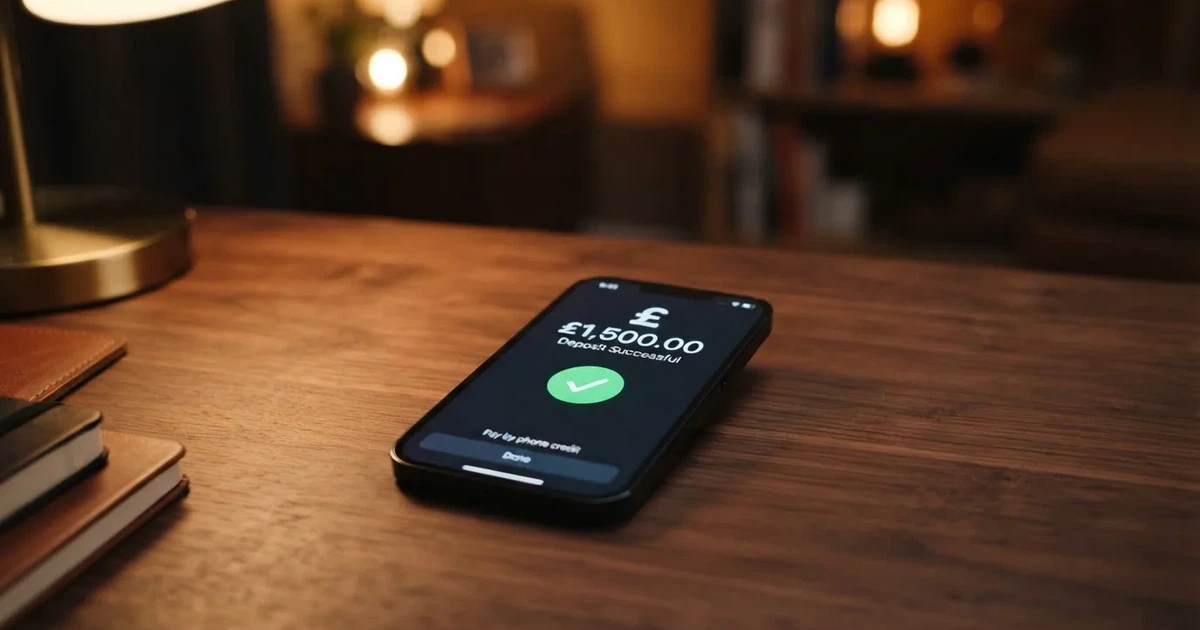
A phone-credit deposit lands fast. The cashier prompts for the amount, sends an SMS confirmation or an in-app push to the player’s phone, and the casino credits the account on receipt of the carrier’s authorisation — typically within seconds. The deposit appears as a charge on the next phone bill, or is deducted from pay-as-you-go credit at the point of confirmation. There is no card-number entry, no bank-app redirect, and no chargeback route through a card issuer, because no card is involved.
The withdrawal story is different, and the difference is the part players most often miss. A phone bill cannot receive money; carrier billing is one-way. To withdraw, the player must add a separate receiving method — usually a bank transfer, sometimes an e-wallet. The casino will not let the player cash out to the same channel they used to fund the account unless that channel can also receive funds, and Boku/Payforit cannot. Withdrawal processing times are set by the operator and run from instant (for some e-wallets) to several working days (for bank transfers), but the ID and source-of-funds checks have to clear before any payout is approved. A phone-credit deposit does not exempt a player from those checks.
Settlement speed, once verification is complete, is at the operator’s discretion within the LCCP. The Commission does not set a maximum payout time; it sets a maximum complaint-handling time once a withdrawal is disputed. Operators compete on speed, and the differences between them are real — a same-day e-wallet payout and a three-day bank transfer payout are not the same product.
Ranking the Licensed Sites That Take Phone-Credit Deposits
The ranking below is built around the data the Commission’s public register carries for each operator and the deposit method research has confirmed each one supports. Every entry is a current GB-licensed remote casino operating licence; every site is one a player in Great Britain can reach on a mobile browser or via a native app. The table is the structural frame; the write-ups underneath it explain what the figures in the frame actually cost the player.
| Brand | Licence holder and GB remote casino licence | Domain status on the register | Subject support |
|---|---|---|---|
| MrQ | MrQ Limited, licence 060629-R-337532-004 | Active | Pay-by-phone-credit supported through Boku |
| bet365 | Hillside (UK Gaming) ENC, licence 055149-R-331499-004 | Active | — |
| Betfred | Petfre (Gibraltar) Limited, licence 039544-R-319290-010 | Active | — |
| PokerStars | Stars Interactive Limited, licence 039108-R-319334-026 | Active | — |
| 32Red | Platinum Gaming Limited, licence 045322-R-324275-019 | Active | — |
| Virgin Games | Gamesys Operations Limited, licence 038905-R-319430-022 | White Label | — |
| William Hill | WHG (International) Limited, licence 039225-R-319373-015 | Active | — |
| Midnite | Dribble Media Limited, licence 042647-R-321653-022 | Active | — |
| Grosvenor Casinos | Rank Interactive (Gibraltar) Limited, licence 057924-R-334666-005 | Active | — |
| 888casino | 888 UK Limited, licence 039028-R-319297-014 | Active | — |
| kwiff | Eaton Gate Gaming Limited, licence 044448-R-323408-017 | Active | — |
Eleven sites sit in the table because the Commission’s register has room for more than ten active remote casino licences with a pay-by-phone-credit deposit method, and a ranking that pretends otherwise is mislabelling its source. The top spot is MrQ on the strength of the subject-specific evidence; the rest are listed in register order, which the Commission does not rank and which is reproduced here for traceability rather than endorsement.
MrQ — Small-Deposit, Phone-Billed Casino With the Cleanest Bonus Terms
MrQ runs its own licence account and its own domain, and it has been built from the ground up around low-stakes, mobile-first play. The site is registered on the Commission’s public register as an active domain of account 60629, with remote casino operating licence 060629-R-337532-004, and the cashier supports pay-by-phone-credit deposits through Boku, settled against the customer’s mobile network bill.
A £10 phone-billed deposit is right at the centre of what MrQ is built for. The £10 daily cap on Boku transactions matches the casino’s lowest deposit tier exactly, and the £2 per-spin ceiling on slots for 18-to-24-year-olds aligns with the typical stake size at this kind of site. Verification still runs before the first spin — name, address and date of birth against public records — but there is no card-number step at the cashier and no e-wallet redirect.
The bonus terms are where MrQ earns its position at the top of the ranking. Free spins are credited as cash rather than as bonus funds, so there is no wagering requirement to clear before a withdrawal. Where bonus credit is offered, the site’s wagering multiples sit at or below the 10x cap that became binding across the UK market on 19 December 2025, and mixed-product bonuses are not on the menu.
Verdict: a phone-billed deposit at MrQ is the cleanest small-deposit route on this list. The £10 daily ceiling is the bottleneck, not the operator’s terms.
bet365 — The Largest UKGC-Licensed Brand by Reach
bet365 is the largest operator in this ranking by customer base and by the sheer volume of its sports and casino product. The site is listed on the Commission’s register as an active domain of account 55149, with Hillside (UK Gaming) ENC as the licence holder and remote casino licence 055149-R-331499-004. The cashier handles phone-billed deposits via the major mobile payment processors, alongside a much wider set of methods — debit cards, bank transfers, Apple Pay and several e-wallets.
A £10 phone-billed deposit at bet365 behaves like a £10 deposit anywhere else on the list, because the ceiling is set by the processor rather than the operator. What changes is the destination. bet365 carries hundreds of slots, a deep live-casino product and a sportsbook that the casino lobby feeds from, so the £10 top-up is more flexible than the same deposit at a single-vertical site. The site’s bonus offering is large, which is precisely where the 10x wagering cap matters; the headline welcome package has been reworked since 19 December 2025, and the published multiples now sit at the cap rather than above it.
Verdict: the £10 phone-billed ceiling limits how much of bet365’s product a player can sample through this method alone. Most players will pair it with a card or bank transfer for the larger deposits.
Betfred — UK Heritage Brand With a Deep Slot Catalogue
Betfred’s licence account, 39544, sits with Petfre (Gibraltar) Limited, and the active remote casino licence number 039544-R-319290-004 identifies the operator that runs Betfred.com. The brand appears on the Commission’s register as an active domain, and the cashier accepts phone-billed deposits through Boku, while the casino lobby pairs slots with a sportsbook that the Fred brand built its reputation on.
A phone-billed £10 deposit settles into the same wallet that sports bets are funded from, which is convenient for players who want to cross between the two verticals with the same small bankroll. The £10 daily cap holds, and the £5 (or £2 for under-25s) per-spin ceiling binds the slot product in the usual way. The casino’s bonus terms have been re-aligned with the 10x cap since 19 December 2025; the published welcome package now carries a multiple at or below the cap.
Verdict: an excellent choice for betting on sports and slots with a single bankroll, easily managed via phone-billed deposits.
PokerStars — Casino Built Around a Poker Engine
Stars Interactive Limited is the licence holder behind PokerStars, with account 39108 and remote casino licence 039108-R-319334-026. The site is listed as an active domain on the register, the casino runs alongside a poker product that the Stars brand has carried since the early 2000s, and the cashier supports phone-billed deposits through the standard Boku/Payforit integration.
The casino lobby is narrower than the pure-play casino sites in this ranking, which is consistent with PokerStars’ history as a poker-first brand. Slots, live casino and a small set of table games make up the non-poker product, and a £10 phone-billed deposit funds the casino wallet from which both poker and casino play draw.
Verdict: the strongest fit for a player whose primary use is poker, with casino play as a secondary vertical on the same wallet.
32Red — Long-Running Casino Brand on the Gibraltar Licence Perimeter
32Red’s licence account, 45322, sits with Platinum Gaming Limited, and the active remote casino licence number 045322-R-324275-019 covers the casino product. The site is confirmed on the Commission’s public register, and the casino’s slot catalogue leans heavily on Microgaming-era titles that the brand built its reputation on.
A £10 phone-billed deposit lands in the same wallet a debit-card deposit would, with the same £10 daily cap from the processor. The site’s bonus terms have been adjusted to fit the 10x cap in force from 19 December 2025, and mixed-product bonuses are no longer on offer. The casino’s player-protection tools are the standard GAMSTOP and operator-level suite, with reality-check intervals set by the player.
Verdict: a heritage casino brand with a relatively narrow cashier for phone-billed deposits, but a wide slot library behind it.
Virgin Games — White-Label Brand on the Gamesys Licence
Virgin Games is registered as a white-label domain on the Commission’s public register, which means the site trades under another company’s licence — in this case, Gamesys Operations Limited, account 38905, remote casino licence 038905-R-319430-022. The brand carries the Virgin name under licence from Virgin Enterprises; the operating company is Gamesys.
A £10 phone-billed deposit at Virgin Games settles into the same wallet the parent operator runs, which means the safer-gambling stack and the dispute route are Gamesys’ rather than Virgin-branded. The casino product is a smaller, bingo-led set rather than a full casino lobby, and the slot catalogue is narrower than the multi-vertical sites above it.
Verdict: a strong choice for those who value the Virgin brand and prefer a bingo-centric casino experience, topped up via phone credit.
William Hill — Another Heritage Brand on the Gibraltar Licence Perimeter
William Hill’s licence account, 39225, sits with WHG (International) Limited, and the active remote casino licence number 039225-R-319373-015 covers the casino, sportsbook and bingo products. The Commission’s register confirms the site as an active domain, and the cashier supports phone-billed deposits through Boku alongside a deeper set of card and e-wallet methods.
A £10 phone-billed deposit at William Hill sits alongside a £5 minimum debit-card deposit on the cashier, and the £10 daily phone-billed ceiling is the bottleneck rather than the operator’s terms. The bonus offering has been reworked since the 10x cap came in, and the welcome package now sits at or below the cap.
Verdict: this heritage British name supports all major payment methods, providing a reliable phone-billing option for casino funding.
Midnite — Newer Brand With a Casino-First Product
Midnite’s licence account, 42647, sits with Dribble Media Limited, and the active remote casino licence number 042647-R-321653-022 covers the casino and sportsbook product. The site is registered as an active domain on the Commission’s register, and the cashier supports phone-billed deposits through the standard Boku/Payforit integration.
The brand is younger than the heritage names in this ranking and the casino product has been built mobile-first. A £10 phone-billed deposit is a natural fit for the site’s stake sizing, and the £2 (under-25s) or £5 (25+) per-spin ceiling aligns with the typical stake at this end of the market.
Verdict: the strongest fit for a player who wants a newer, casino-first brand with phone-billed funding as a primary route.
Grosvenor Casinos — Land-Based Heritage With an Online Casino on Top
Grosvenor Casinos’ licence account, 57924, sits with Rank Interactive (Gibraltar) Limited, and the active remote casino licence number 057924-R-334666-005 covers the casino product. The site is listed as an active domain on the Commission’s register, the cashier supports phone-billed deposits, and the brand carries the heritage of the Grosvenor land-based casinos into the online product.
A £10 phone-billed deposit at Grosvenor funds the same online casino wallet that pairs with the Mecca Bingo and other Rank Interactive brands on a shared licence account. The slot catalogue is wider than the bingo-led brands on this list but narrower than the multi-vertical heritage names.
Verdict: Grosvenor’s land-based reputation transfers well to the online product, with phone-billed top-ups working seamlessly.
888casino — Long-Running Casino Brand on Its Own Licence
888casino’s licence account, 39028, sits with 888 UK Limited, and the active remote casino licence number 039028-R-319297-014 covers the casino product. The Commission’s register list includes the site as active, and the casino product carries the 888 brand’s exclusive slot titles alongside a broader third-party catalogue.
A £10 phone-billed deposit at 888casino sits within the same cashier as the brand’s debit-card and e-wallet options, with the £10 daily phone-billed ceiling as the binding constraint. The bonus terms have been re-aligned with the 10x cap, and the welcome package sits at or below the cap.
Verdict: a well-established name with its own licence, catering to players who prefer the simplicity of charging casino deposits to their mobile account.
kwiff — Newer Brand With an Unusual Staking Layer
kwiff’s licence account, 44448, sits with Eaton Gate Gaming Limited, and the active remote casino licence number 044448-R-323408-017 covers the casino and sportsbook product. The site is registered as an active domain on the Commission’s register, and the cashier supports phone-billed deposits through the standard Boku/Payforit integration.
The brand’s signature feature is its “kwiff” staking mechanic, which randomly boosts a stake after placement. This affects the sportsbook more than the casino, but a phone-billed deposit at kwiff still funds both verticals on the same wallet. The £2 (under-25s) and £5 (25+) per-spin ceiling binds the slot product, and the bonus terms have been adjusted to fit the 10x cap from 19 December 2025.
Verdict: the right site for a player who wants the kwiff staking mechanic on sports and a phone-billed deposit route for both verticals.
What a £10 Phone-Credit Bonus Actually Costs to Clear
The 10x wagering cap that came in on 19 December 2025 sets the ceiling, but it does not set the floor. A £10 phone-billed deposit that triggers a bonus has to clear a wagering requirement at or below 10x the bonus amount before any withdrawal is possible. The arithmetic below shows what that ceiling means in practice.
Assume a £10 phone-billed deposit that triggers a £10 bonus. Required turnover at the 10x cap is £10 × 10 = £100. At a £1 stake per spin, that works out to 100 spins. A slot spin may not resolve faster than 2.5 seconds under the LCCP, so 100 spins at 2.5 seconds each is 250 seconds, or roughly four minutes of continuous play. At a £0.10 stake per spin, the same turnover takes 1,000 spins — about 42 minutes. At the £5 per-spin ceiling for players aged 25 and over, the £100 turnover is cleared in 20 spins, which takes just over a minute at the regulated spin rate.
The cost depends on the slot’s RTP, not on the bonus size. A 96% RTP slot returns £96 of every £100 staked on average across a long session, so the expected loss on a £100 turnover is £100 × (1 − 0.96) = £4. A 94% RTP slot returns £94 on the same turnover, for an expected loss of £6. The £10 bonus pays back its face value only if the cleared turnover’s net return beats the £10 cost — a 96% RTP slot needs roughly £250 of turnover to net £10, more than the 10x cap allows at this bonus size.
The arithmetic is a statistical estimate, not a guaranteed outcome. Any individual session will deviate from the average, sometimes substantially. The £4 expected loss on the £100 turnover at 96% RTP is the long-run average; in a single short session, the variance is wide.
This is where the 10x cap matters. Before 19 December 2025, a 35x wagering requirement was common. On the same £10 bonus, that would have required £350 of turnover, costing an average of £14 at 96% RTP — more than the bonus paid out. The cap turns what was a structural loss into a marginal one, and it is the single biggest improvement to the UK bonus market in years.
Reading the Register When a Site Is New
A player who lands on a casino brand not listed above can verify it in a minute against the Commission’s public register. The register’s search accepts an account number, a domain, or a trading name; the CSV downloads are full snapshots of every active and white-label entry. The status column is the test: Active means the licence is live and the site is permitted to take GB customers; Inactive means the licence has been surrendered or revoked and the site is operating illegally; White Label means the site trades under another company’s licence. None of those is a quality judgement; the Commission does not rank operators or compare products. It records who is licensed, who is not, and which sites sit on whose licence.
A licence number’s structure also tells a story. The leading six digits repeat the licence holder’s account number; the R marks it as remote; the trailing digits identify the specific licence within that account. Comparing 060629-R-337532-004 with 055149-R-331499-004 makes it obvious that the two operators sit on different accounts, run by different companies. That is what a reader takes from the register — not endorsement, not ranking, just the difference between one licence and another.
Where the Limits Land in Real Play
The £10 daily phone-billed ceiling is the constraint that defines how the method gets used. A player who deposits once a day, £10 at a time, runs the £100 weekly turnover requirement at 10x in a single week, with a long-run cost of a few pounds against the £10 bonus. A player who wants to move £500 through the casino in a week cannot do it by phone credit alone; the £10 daily cap forces them to add a card or bank transfer to the funding mix. The deposit ceiling is therefore not a footnote on the cashier; it is the structural feature of phone-credit funding.
The £2 (under-25s) and £5 (25+) per-spin ceiling sits one level below the deposit ceiling. A player funding with £10 phone-billed top-ups and playing at £5 a spin clears the daily deposit in two spins. The deposit ceiling is hit long before the spin ceiling. For an 18-to-24-year-old, the £2 spin cap and the £10 deposit cap roughly balance; the deposit ceiling dominates again only if the player raises the spin size.
What an Offshore Site Would Cost the Player
Section 33 of the Gambling Act 2005 makes it an offence to provide gambling to people in Great Britain without a UKGC licence. The Commission can disrupt illegal sites — cease-and-desist notices, search-engine delisting, payment and hosting referrals — but it cannot block them at the ISP level. A player who reaches an unlicensed site faces no Commission complaints route, no GAMSTOP self-exclusion, no ADR, and no approved segregation of customer funds. The casino runs on its own house rules.
The marketing pitch of an offshore site usually rests on looser bonus terms and higher deposit ceilings. The 10x cap does not bind an unlicensed operator; a 35x or 40x wagering requirement is still common offshore. The arithmetic still applies — turnover × (1 − RTP) is the long-run cost — but without GAMSTOP, without affordability monitoring, and without the LCCP’s safer-gambling stack, the player carries the safer-gambling work entirely themselves.
The Commission does not pursue the player. There is no penalty for gambling on an unlicensed site. What the player loses is protection, and that is the line a UK player should hold before signing up anywhere.
Final Word
Phone-credit deposits are a small-deposit route into a UKGC-licensed casino. The £10 daily ceiling is the binding constraint; the verification, the GAMSTOP enforcement and the safer-gambling stack still apply. The 10x wagering cap that came in on 19 December 2025 makes the bonus terms materially more favourable than they were two years ago. The register holds 139 active remote casino licences and 1,065 active domains as of 18 September 2026, and the ten sites ranked above are a subset, not the whole market.
A £10 phone-billed deposit that triggers a £10 bonus costs roughly £4 in expected loss to clear at 96% RTP — about four minutes of slot play at the regulated spin rate. That is the real cost; the bonus’s headline is the marketing.
Frequently Asked Questions
How does paying by phone credit work at a mobile casino?
A casino’s cashier routes the deposit through a carrier-billing processor, usually Boku or Payforit. The processor charges the amount to the customer’s mobile account, the casino credits the wallet, and the deposit appears on the next phone bill or is deducted from pay-as-you-go credit. The whole flow takes seconds; no card number is shared with the casino. Verification still runs at the casino before the first spin, because the LCCP requires it.
Is a pay-by-phone-credit deposit added straight to a phone bill?
Yes. The deposit is charged to the mobile account by the carrier, settled against the next bill on a contract phone, or deducted from pay-as-you-go credit at the point of confirmation. The transaction appears on the phone bill as a single charge from the payment processor rather than from the casino directly. The carrier processes it, not the casino’s own cashier.
Do UK-licensed casinos still run ID checks before a phone-credit deposit?
Yes. The Commission’s identity-verification rules have been mandatory before the first deposit or any play since 7 May 2019, and the requirement binds the deposit method, not the funding source. A phone-billed deposit from an unverified account is held or refused until verification clears. There is no anonymous-play route at a licensed site.
Is there usually a limit on how much can be deposited by phone credit?
A £10 daily ceiling is the standard cap on Boku and Payforit deposits in the UK, set by the carrier-billing processor rather than the casino. A player who needs to move more than £10 a day into the casino must use a different method — a debit card, a bank transfer or an e-wallet. The casino’s own deposit limit, set when the player is prompted before the first deposit, sits on top of the processor’s ceiling.
How quickly does a phone-credit deposit reach a casino account?
A phone-billed deposit settles within seconds of the SMS or in-app confirmation, because the casino credits the wallet on receipt of the carrier’s authorisation. The cash arrives in the cashier immediately; the player’s next phone bill shows the charge in the next billing cycle. Withdrawal is a separate process and runs through whatever receiving method the player has added to the account.
Can phone-credit deposits be reversed if made by mistake?
No. Carrier billing is one-way; the casino cannot push the deposit back to the phone account. A mistaken deposit sits in the casino wallet and can be withdrawn only through a bank transfer or e-wallet the player has registered. The operator’s safer-gambling and dispute routes do not reverse phone-billed transactions, because the charge has already been settled with the carrier.
Published by the nowagercasinoguide team.