
Online Casino Tournaments in the UK for 2026: A Working Reader’s Guide to the Leaderboards
A slot tournament is a marketing wrapper around the same slots a player can already play for cash. The casino picks a window, picks a title or a small set of titles, and ranks every entrant by a score — most often total win amount across a fixed number of spins, sometimes best single spin, sometimes total turnover. The top of the leaderboard takes the prize pool, the rest take nothing. That is the whole product. Everything else on the page — entry fees, prize structures, free-roll versions, the loyalty points that double as tournament tickets — is a variation on how a casino decides who counts as entered and what gets paid at the end.
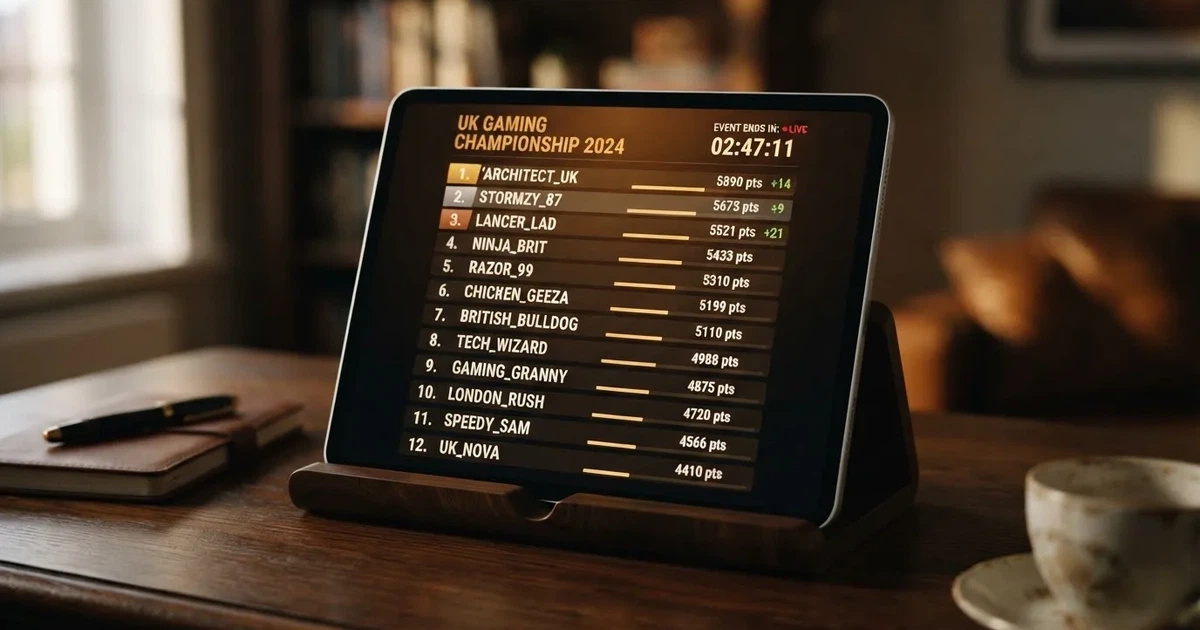
The reason tournaments sit on a UK Gambling Commission page rather than on any other gambling site is that they are a promotional format, not a separate game. The slots underneath are still the licensed slots; the leaderboard is a layer on top. That single fact does most of the work this guide is built around, because the same stake caps, the same age verification, the same credit-card ban, the same 10x wagering cap on bonuses, and the same GAMSTOP enrolment apply to whatever promotional shape the leaderboard takes. The rules do not bend for tournaments, and the player’s protections do not disappear because the page is dressed up as a competition.
This page is built for the reader who wants to know what a tournament actually costs in time and money, how the prize pool is split, how quickly a win lands, and which operator’s version of the same idea is worth entering. The lens is the cost to the player — what gets spent, what gets wagered, what gets paid back, and what gets quietly taken off the top before the player sees it. The arithmetic appears in one place, in plain prose, with its inputs and its conclusion. The comparison across operators covers ten Gambling Commission-licensed brands, none of them recommended as a place to play, all of them named because they sit on the Commission’s public register and run the format this page is about.
Currency and register data current as of 7 November 2026, verified against the Gambling Commission’s public register of gambling businesses.
- How Tournaments Get Paid Out — and Where the Money Goes
- Tournament Bonuses and Free Spins — What the “Prize” Actually Costs
- Slot Titles and Studios Behind the Leaderboards
- The Ten Brands on the Commission’s Register
- What the Commission’s Register Actually Says — and What It Does Not
- The Rules Around Tournaments — Stake Caps, Age Checks and the Credit-Card Ban
- Offshore Sites and What They Cost the Reader
- Crypto and the Tournament Question
- The Arithmetic of a Tournament Prize
- The Honest Reading of the Ten Brands
- A Note on the Offshore Question
- Frequently Asked Questions
How Tournaments Get Paid Out — and Where the Money Goes
The first question on any leaderboard page is the same one any reader would ask of a cashier: when the timer stops, how quickly does the prize land? The honest answer is that tournament payouts follow exactly the same rails as a normal withdrawal from the same operator, because the prize is paid as a cash balance, not as a slot-credit voucher or a bonus with conditions attached. The leaderboard is a contest; the payout is a withdrawal. Knowing the difference matters, because the second is the part the player has to wait for.
The rails the money travels on
Inside the UK, almost every casino withdrawal travels through one of three rails. Bank transfers almost always run through the Faster Payments Service, the 24-hour scheme Pay.UK has operated since 2008; most arrive within minutes, occasionally up to a couple of hours. Apple Pay sits behind the same card rails — the casino sees a Visa or Mastercard debit under tokenisation, with the device-specific Device Primary Account Number doing the work, and a dynamic security code per transaction. AstroPay sits behind an electronic-money wallet that the UK arm, Larstal Limited, runs under FCA authorisation, with a separate Isle of Man, Danish and Brazilian entity handling cross-border traffic.
The Faster Payments ceiling per single transaction is £1,000,000, though a player’s own bank can set the limit lower; tournament prizes fit comfortably under either. AstroPay’s UK arm settles to a UK bank account through the same Faster Payments plumbing, with the wallet acting as the bridge. Apple Pay is a presentation layer over a debit card; the underlying card payment has to clear before the balance shows in the casino cashier. None of these rails is specific to tournaments, and none of them is faster because the deposit came from a leaderboard rather than from a regular session.
What “instant” actually means on a tournament page
Casino marketing pages use the word “instant” the way they use the word “free”: loosely, and to mean something a reader will not check until the moment it matters. The Faster Payments ceiling is generous, the system runs around the clock, and the receiving bank credits most transfers within seconds. The casino’s internal release time is what holds the payment up. A withdrawal request at 23:50 on a Saturday can sit in a “pending” queue until Monday morning’s payments team is back at the desk, even though the underlying rail would have moved it in minutes. That is the part “instant” tends to hide.

What the player should expect, in the realistic best case, is minutes to a couple of hours once the casino releases the payment, with a bank holiday weekend adding up to a working day’s wait at the queue end. AstroPay and Apple Pay do not shorten the queue; they lengthen the chain. A tournament prize paid into a wallet and then forwarded to a UK bank picks up the wallet’s own processing window on top of the casino’s.
Tournament Bonuses and Free Spins — What the “Prize” Actually Costs
The promotional language around tournaments runs hot. “Boosted prize pools”, “guaranteed”, “free entry”, “cash drops” — every one of those words is selling something with a number attached, and the number that decides whether the offer is worth entering sits a few paragraphs further down the terms page, in the section that explains how the bonus is paid and what the player has to wager before it becomes withdrawable cash.
The 10x cap, in force since 19 December 2025
Since 19 December 2025, the Gambling Commission has capped wagering requirements on bonuses at 10x. A £10 tournament prize paid as a bonus carries a maximum of £100 of wagering before it converts to withdrawable cash; a £100 prize carries £1,000; a £1,000 top prize carries £10,000 of qualifying play. That is the ceiling. Anything the operator offers above it is either not a bonus (it is paid as cash) or it is not compliant. The cap is one of the rules the LCCP puts on every Commission-licensed brand, so it applies uniformly across the ten operators reviewed on this page.
The cap matters most at the top of the leaderboard, where the prize figure looks the most attractive. A £500 first-place payout with 10x wagering means £5,000 of qualifying turnover before the £500 becomes withdrawable. On a slot at 96% RTP the expected loss through that turnover is £200; on a slot at 94% RTP it is £300. Either figure is a cost the player pays on top of the deposit they made to enter, and either figure eats most of the prize before the player ever sees it.
The band a £100 prize actually takes
To put the 10x cap into something a reader can hold: a £100 tournament prize paid as a bonus requires £1,000 of qualifying wagering before withdrawal. On a £1-per-spin slot, that is 1,000 spins — roughly 42 minutes at the Commission’s 2.5-second minimum spin interval, or getting on for five and a half hours at a relaxed pace of three spins a minute. The arithmetic belongs on the page because the promotional page does not show it; the promotional page shows the prize.
Two consequences follow. First, the smaller the prize, the larger the wagering burden as a share of it. A £20 tournament prize costs the player £200 of qualifying turnover and roughly £8 to £12 of expected loss on a typical slot, which is 40% to 60% of the headline prize before the player sees it. The “free” tournament has quietly taken a chunk off the top. Second, the bigger the prize, the longer the qualifying play, which is the part the reader who works a nine-to-five cannot easily fit around. A £500 first-place payout is a four-figure playthrough and a long afternoon at the screen.
Mixed-product bonuses are out
Since the same 19 December 2025 reform package, mixed-product bonuses have been banned: an offer that ties a sports bet to a slot-tournament ticket, a casino-deposit bonus that unlocks a leaderboard entry, any bundle that crosses product lines is no longer a permitted format. The change closed a marketing shape that had been common — “bet £10 on the football, get a tournament entry” — because it hid the casino-side wagering inside the sports-side condition. The result for the reader is that a tournament entry bought with anything other than cash, loyalty points, or a pure free-roll is now harder to find.
Free-roll and no-deposit versions
A “no-deposit tournament” is one a player can enter without making a deposit first. The entry fee is zero; the prize pool is funded by the casino, not by the entrants; the prize is typically smaller than the paid equivalent. Free-rolls are the legitimate route for a player who wants to feel the format without committing bankroll, and they are the only form of tournament entry a careful reader should approach without reading the terms first — the qualifier on a no-deposit prize can be heavier than the qualifier on a paid prize, because the casino is giving something away and wants its money back before the player walks off.
The honest question to ask of any no-deposit tournament is whether the entry results in cash or a bonus balance. Cash is withdrawable on receipt, subject only to the casino’s standard identity check on first withdrawal. A bonus carries the wagering cap. The headline word “free” covers both.
Slot Titles and Studios Behind the Leaderboards
The title a tournament runs on matters more than the prize figure, because the score a leaderboard records is the product of stake, hit rate and volatility across a fixed number of spins. A high-volatility title with a 5% hit rate and a £2 stake will produce a handful of very large wins per hundred spins, while a low-volatility title at the same stake produces a steady stream of small wins. The leaderboard format determines which player profile each title suits.
Which titles recur on UK leaderboards
Pragmatic Play’s Drops & Wins network runs a year-long tournament format that most Commission-licensed brands opt into; the prize pool is funded by the studio rather than by the individual casino, the qualifying titles are the studio’s own catalogue, and the entry is automatic on any qualifying spin. Pragmatic’s titles sit in the medium-to-high volatility band, which produces occasional large wins that lift a leaderboard entry. NetEnt’s older catalogue — Starburst, Gonzo’s Quest — tends to appear in the lower-volatility end of the format, which suits a player who would rather play a long session and grind a position than chase a single large win.
Play’n GO, Nolimit City and Hacksaw Gaming fill the higher-volatility slot of the format. A leaderboard on a Hacksaw title is a different contest from a leaderboard on a Pragmatic one: the variance is wider, the qualifying spins are fewer, and the winner is more likely to have caught a single outlier round rather than ground out a steady position. The studio choice is a player-profile choice the leaderboard page does not usually spell out.
The 2.5-second rule and what it does to a contest
Since 31 October 2021, slot spins in Great Britain cannot run faster than one every 2.5 seconds, and auto-play is banned. The rule was framed as a player-protection measure; it has a quiet effect on tournaments as well. A 100-spin tournament that would once have taken fifteen minutes now takes twenty-five. A 500-spin tournament that would once have been a lunch break is now an evening. The cost of entering the contest has gone up not because the entry fee rose but because the regulatory floor under the spin speed extended the time the contest takes to play.
For a reader who works, this is the practical point: an evening-length tournament is a different commitment from a lunch-break tournament, and the prize pool is the same. The arithmetic that follows further down this page uses a 2.5-second interval as its baseline, because anything faster would not be legal at a licensed site.
The Ten Brands on the Commission’s Register
Every operator on this page sits on the Gambling Commission’s public register as the holder of an active remote casino operating licence. The register is the test of whether a brand is licensed to take UK players at all. The licence number carries the form account-R-number-suffix, with the leading six digits repeating the licence holder’s account number and the “R” marking a remote (online) licence. Each entry below names the brand, the licence account, the licence holder, and the licence number, taken from the register’s CSV download on 18 September 2026.
Several of the brands below share a single licence holder. Ladbrokes, Coral and Gala Bingo all sit under LC International Limited, which holds the licence 054743-R-330863-014; they are not independent operators for the purposes of the Commission register, even though they trade under separate brands. The table at the end of this section shows the licences against the domains as they sit on the register.
Paddy Power
Paddy Power runs on the PPB Games Limited account 39411, with the licence 039411-R-319335-010. The brand has the largest sportsbook presence in the Irish and UK markets, and its casino product carries a tournament schedule built around Drops & Wins-style network promotions on the Pragmatic Play catalogue, with smaller in-house leaderboards on selected slots. The site’s tournament page is integrated with the sportsbook rather than sitting in a separate casino tab, which is the format a sportsbook-led brand tends to favour.
The judgement this page makes of Paddy Power is that the tournament offering is broad and the prize pools are competitive for the network format, but the volume of sportsbook-led promotional cross-sell makes it easy for a player to land in a leaderboard through a path they did not intend. A reader who values tournament entries they have chosen deliberately will find the navigation harder work than the casino-led brands below.
Ladbrokes (Ladbrokes.com)
Ladbrokes runs on the LC International Limited account 54743, sharing the licence 054743-R-330863-014 with Coral and Gala Bingo. The brand’s casino tab carries a regular tournament schedule on a mix of in-house and network formats, with the bulk of the schedule on the Pragmatic Drops & Wins network. The casino product is part of a wider group platform that shares its cashier, its GAMSTOP integration and its player-protection tooling across the three LC International brands.
The verdict is that Ladbrokes suits a reader who already has an LC International account and values the integration across the group’s brands, but the tournament offering does not stand out from the network-format baseline. Overall, this brand matches the industry standard for this format.
MrQ (Mrq.com)
MrQ runs on the Tek Fox Ltd account 60629, with the licence 060629-R-337532-004. The brand is the only casino-only operator in this list; there is no sportsbook, no bingo tab, no poker room. The tournament schedule is smaller than the network-led brands but is built around the casino product rather than grafted onto a sportsbook, which makes the leaderboard the focus of the page rather than one tab among several.
The judgement is that MrQ suits a reader who wants the casino-only experience and a tournament schedule they can read in one place rather than navigate around a wider product. The brand’s tournament prize pools are smaller than the network-led brands’, which is the trade a reader makes for the cleaner navigation.
Coral (coral.co.uk)
Coral sits on the same LC International Limited account as Ladbrokes and Gala Bingo, under the licence 054743-R-330863-014. The brand’s casino tab carries a similar tournament schedule to Ladbrokes, built on the same group platform and the same network-led formats. The cashier, the GAMSTOP integration and the player-protection tooling are shared across the three LC International brands, and a player enrolled in GAMSTOP through one is enrolled across all three.
The verdict is the same as Ladbrokes’: a reader already in the LC International group will find the integration useful, and a reader who values a joined-up account experience will prefer this option.
bet365 (Bet365.com)
bet365 runs on the Hillside (UK Gaming) ENC account 55149, with the licence 055149-R-331499-004. The brand carries the largest casino product by game count among the operators on this list, and the tournament schedule is correspondingly broad. The site’s tournament pages sit in a separate casino tab and are organised by game provider, with separate leaderboards for each network and for the in-house schedule. The volume is the point: a reader who wants to choose between several concurrent tournaments will find more concurrent tournaments here than at the smaller operators.
The judgement is that bet365 suits a reader who wants to pick the tournament rather than have the casino pick it for them. The trade is the navigation: a brand with the volume bet365 carries takes longer to read than a smaller competitor, and the player has to do the picking the operator has not done for them.
Betfred
Betfred runs on the Petfre (Gibraltar) Limited account 39544, with the licence 039544-R-319290-010. The brand carries a casino product alongside a sportsbook and a bingo tab; the tournament schedule is part of the casino offering rather than a separate product. The site’s tournament pages are integrated with the wider promotional calendar, and a player with an active sportsbook account will see tournament entries surfaced as cross-promotion.
The verdict is that Betfred suits a reader who already plays the sportsbook and values the cross-promotion between the two products. A player focused on tournament play will likely find more specialised options elsewhere.
Casumo (Casumo.com)
Casumo runs on the Recro Limited account 61549, with the licence 061549-R-336718-002. The brand carries one of the more recognisable casino-led designs in the UK market, with a tournament schedule built around the Pragmatic Drops & Wins network and a smaller in-house schedule on selected titles. The site’s tournament tab is a separate area rather than a fold of the casino lobby, which makes the schedule easier to read than at the sportsbook-led brands.
The judgement is that Casumo suits a reader who values the casino-led navigation and a tournament tab they can read in one pass. The prize pool is the network-format baseline; the brand does not stand out from the network on size.
888casino
888casino runs on the 888 UK Limited account 39028, with the licence 039028-R-319297-014. The brand is one of the longer-established casino brands in the UK market and carries a tournament schedule built around the in-house 888 network as well as the Pragmatic Drops & Wins feed. The site’s casino tab is the primary navigation, with the tournament schedule sitting in a sub-tab.
The verdict is that 888casino suits a reader who values a casino-led site with a long track record on the UK register. The tournament schedule is broader than the smallest operators but not as dense as bet365’s; the trade is between brand familiarity and tournament volume.
Jackpotjoy (Jackpotjoy.com)
Jackpotjoy runs on the Gamesys Operations Limited account 38905, with the licence 038905-R-319430-022. The brand is one of the longer-established bingo-led brands in the UK market, and its casino tab carries a smaller tournament schedule than the network-led brands. The site’s primary product is bingo; the casino and the tournament schedule are secondary tabs.
The verdict is that Jackpotjoy suits a reader who already plays the bingo product and values the integration with it. It serves the bingo-first market well, though tournament players have other dedicated options.
Gala Bingo
Gala Bingo sits on the same LC International Limited account as Ladbrokes and Coral, under the licence 054743-R-330863-014. The brand’s primary product is bingo; the casino tab carries a tournament schedule that is part of the wider LC International group platform. A player enrolled in GAMSTOP through one LC International brand is enrolled across all three.
The verdict is that Gala Bingo suits a reader who already plays the bingo product and values the integration with it. The casino tournament schedule is the same network-format baseline as the other two LC International brands.
The licences against the domains
The table below sets out each operator against the licence holder, the licence number and the domain status on the register, taken from the Commission’s CSV download on 18 September 2026. Three of the brands sit under the same LC International licence; the rest are independent licence holders within the Commission’s register. The table’s last column shows whether research carries a tournament-specific data point for each brand; it does not, so every row carries the article-language no-data marker, and the brands are presented on their other fields.
| Brand | Licence holder | GB remote casino licence | Domain status on the register | Tournament-specific data |
|---|---|---|---|---|
| Paddy Power | PPB Games Limited | 039411-R-319335-010 | Active | — |
| Ladbrokes | LC International Limited | 054743-R-330863-014 | Active | — |
| MrQ | Tek Fox Ltd | 060629-R-337532-004 | Active | — |
| Coral | LC International Limited | 054743-R-330863-014 | Active | — |
| bet365 | Hillside (UK Gaming) ENC | 055149-R-331499-004 | Active | — |
| Betfred | Petfre (Gibraltar) Limited | 039544-R-319290-010 | Active | — |
| Casumo | Recro Limited | 061549-R-336718-002 | Active | — |
| 888casino | 888 UK Limited | 039028-R-319297-014 | Active | — |
| Jackpotjoy | Gamesys Operations Limited | 038905-R-319430-022 | Active | — |
| Gala Bingo | LC International Limited | 054743-R-330863-014 | Active | — |
Three of the licence numbers in this table are the same. That is not an error; LC International Limited holds one licence, and the three brands sit on it. A reader cross-checking the brands against the register should expect to find three rows in the domain list pointing at one licence account.
What the Commission’s Register Actually Says — and What It Does Not
The Commission’s public register is the test of whether a brand is licensed at all. On 18 September 2026 it listed 139 businesses holding an active remote casino operating licence. The register is searchable online and downloadable as a CSV or an Excel file, which is the form this page’s licence data is taken from. Every brand on the comparison table above sits on the register as the holder of an active licence; none of them is an offshore operator trading on a Curaçao, Maltese or Gibraltar number.
The shape of the register
The register has three parts that matter to a reader. The first is the licence-holder list: 139 businesses, each with an account number, a trading name, and a set of licence numbers under the Gambling Act 2005. The second is the domain list: each licensed website is recorded against the licence account that runs it, with a status of Active, Inactive or White Label. A white-label site trades under another company’s licence, which is the structure a number of UK-facing brands use; on 18 September 2026 the register held 1,065 active and 361 white-label domain entries. The third part is the personal-licence list, which carries the names of the people the Commission has approved to run the licensed operation; that part is not relevant to a tournament page.
The licence number on the register has the form account-R-number-suffix. The leading six digits repeat the licence holder’s account number; the “R” marks a remote (online) licence; the trailing suffix is the sequence number for licences issued under that account. A reader who wants to verify a brand against the register should look up the licence number on the Commission’s public register search, confirm the trading name matches the licence holder, and confirm the domain sits in the active list against the same account.
What the register does not tell a reader
The register confirms that the brand is licensed; it does not confirm that the brand pays out fast, that the bonus terms are fair, that the tournament schedule is generous, or that the player experience is any good. Those questions are answered by reading the operator’s own terms and by trying a small withdrawal. The register is the floor; the rest is judgement.
A second thing the register does not do is grade operators. It is a list of every licensed business, not a league table. The ten brands on this page are ten brands on the register; they are not a ranking and not a recommendation. The judgement sections above are the page’s reading of each brand; the register only confirms the licence.
The Rules Around Tournaments — Stake Caps, Age Checks and the Credit-Card Ban
Tournaments sit under the same regulatory framework as the slots they run on. The stake caps, the age-verification rules, the credit-card ban, the wagering cap, the GAMSTOP enrolment, and the reality-check requirements all apply to whatever promotional shape the leaderboard takes. A reader who already plays slots at a Commission-licensed site knows most of this; the parts that bear on tournaments specifically are the ones this section works through.
Stake caps and the 2.5-second floor
Since 9 April 2026, online slots at Commission-licensed sites carry a maximum stake of £5 per game cycle for players aged 25 and over. Since 21 May 2026, players aged 18 to 24 face a £2 ceiling. The stake cap is on the slot itself, not on the tournament entry fee; a tournament entry that grants 100 spins at £1 each is a £100 stake over the session, all of which is covered by the £5-per-cycle cap. Since 31 October 2021, slot spins cannot run faster than one every 2.5 seconds, and auto-play is banned, which extends a 100-spin tournament from fifteen minutes of play to twenty-five.
The two rules together determine the cost of a tournament session in time. A 500-spin tournament at the £2 stake cap for an 18-to-24-year-old is £1,000 of qualifying turnover, which is twenty-one minutes at three spins a minute or just under two and a half hours at a relaxed pace. A reader who works should expect a tournament session of that size to take a working evening rather than a lunch break.
Age verification, the deposit prompt and the vulnerability check
Since 7 May 2019, every Commission-licensed site has to verify a player’s name, address and date of birth before the first deposit or any play. Anonymous play is not possible at a licensed site. The same framework requires the operator to prompt a customer to set a financial limit before the first deposit; the rule took effect on 31 October 2026 and applies to every Commission-licensed brand on this page.
Financial vulnerability checks run at £150 net deposits in a rolling 30-day window, with public-data checks only; wider financial risk assessments have been announced but are not yet in force. The vulnerability check is not a credit check; it is a public-record check that catches markers the player has not declared. A reader who has set a self-exclusion through GAMSTOP will be stopped at the cashier rather than at the vulnerability-check stage, because GAMSTOP enrolment blocks account opening at every licensed site for the period the player chose (six months, one year or five years, with no early cancellation).
The credit-card ban and what it means for tournament entries
Since 14 April 2020, the use of credit cards to fund gambling has been banned across all online and offline products in Great Britain, with the narrow exception of non-remote lotteries paid for face-to-face. The ban extends to credit cards routed through e-wallets, which is the part a reader should know about: loading a credit-funded balance into an e-wallet and then depositing from the e-wallet is a credit-card-funded gambling transaction and is not permitted. Debit cards and bank transfers are unaffected.
The Commission estimated in its 2020 consultation that around 800,000 UK consumers used credit cards to gamble in 2018, and found that 22% of online gamblers who used credit cards to gamble were classed as problem gamblers. The ban was a player-protection measure; the consequence for a tournament reader is that the deposit rail to a tournament entry has to be a debit card, a bank transfer, or an e-wallet funded from a debit card or bank transfer. Apple Pay works because it sits behind a debit card; AstroPay works because it sits behind a wallet that has to be funded from a permitted source.
Reality checks and time-outs
Reality checks — the periodic pop-up that tells a player how long they have been playing and how much they have spent — are required at every Commission-licensed site. The interval is set by the operator within the LCCP framework, and a tournament session will trip the reality check the same way a regular session does. Time-outs, the short self-exclusion tool of twenty-four hours to six weeks, are available at every site. GAMSTOP is the longer tool, with periods of six months, one year or five years, and no early cancellation.
A tournament reader who is planning a long session should set a time limit before entering. Competitive leaderboards push play beyond a planned budget because the contest has a deadline the player’s own wallet does not, and the deadline is what a session tends to overrun. The reality-check prompt is the safeguard; the time limit the player sets is the one that holds.
Offshore Sites and What They Cost the Reader
The Commission’s framework applies only to operators it licenses. A Curaçao-licensed or Malta-licensed site that targets UK players without a Commission licence is breaking section 33 of the Gambling Act 2005, which makes it an offence to provide gambling to people in Great Britain without a Commission licence. The Commission disrupts illegal sites through cease-and-desist notices, search-engine delisting referrals, and payment and hosting referrals; it has no ISP-blocking power. The penalty is not aimed at the player; what the player loses on an unlicensed site is the protections the Commission’s framework would have given.
What the player loses by going offshore
A player on an unlicensed site has no GAMSTOP enrolment, because GAMSTOP is a condition of every Commission licence. A player who has set a self-exclusion and goes to an offshore site to play through it has walked out of the protection the exclusion was designed to give. The Commission’s complaints route is closed, because the Commission only handles complaints about the operators it licenses. The approved ADR bodies — the independent dispute resolution services the LCCP requires — are only available at licensed sites. A dispute over a tournament prize on an unlicensed site has no UK route to a resolution.
The credit-card ban is a UK rule, and an offshore site does not enforce it; a player who funds an offshore account with a credit card is using a rail the Commission has banned and that the offshore operator is not required to refuse. The 10x wagering cap is a UK rule, and an offshore site can offer a 40x bonus without breaking any rule it is bound by. The stake caps and the 2.5-second spin floor are UK rules, and an offshore site can run a 1-second auto-play at a £20 stake. Each of those freedoms is a protection the player has given up by leaving the licensed market.
How to read the register before signing up
The fastest check a reader can do before depositing anywhere is to look up the brand on the Commission’s public register, confirm the licence number matches the licence holder, and confirm the domain sits in the active list. If the brand does not appear on the register, the brand is not licensed to take UK players, and the protections this page is built around do not apply. The register search is at the Commission’s website; the data behind it is the same CSV the licence table above is built from.
Crypto and the Tournament Question
The crypto casino tournament landscape exists because some operators accept crypto deposits, and a reader who holds coins rather than pounds wants to know whether the coins work as a tournament-entry rail. The honest answer in the UK licensed market is that they do not, because the Commission’s framework requires the same deposit, withdrawal and identity checks whatever the funding source, and the framework runs on sterling.
Why crypto is not a tournament rail at a licensed site
A Commission-licensed site has to verify the player’s name, address and date of birth before the first deposit, which is a sterling-account check. The deposit has to clear through a UK-regulated payment rail — debit card, bank transfer, or a wallet funded from a permitted source — which crypto is not. The withdrawal has to land in a UK bank account or a wallet that can settle to one, which a crypto wallet cannot do without converting through an exchange that is itself FCA-registered for the purpose. The 10x wagering cap and the GAMSTOP enrolment apply to the sterling balance a player holds at the licensed site, not to a separate crypto balance held at an offshore exchange.
An offshore site that takes crypto and runs tournaments is doing so under a different regulatory framework from the Commission’s. The protections this page is built around — the 10x cap, the credit-card ban, the GAMSTOP enrolment, the stake caps, the ADR complaints route — do not extend to that site. A reader who holds coins and wants to play tournaments inside the Commission’s protections has to convert to sterling at an FCA-registered exchange, deposit the sterling through a permitted rail, and play on the licensed site.
The tokenisation layer the player should know about
The Commission framework runs on tokenised payment data even where the rail is a familiar card. Apple Pay replaces the card number with a device-specific Device Primary Account Number and generates a dynamic security code per transaction; the casino sees the tokenised data, not the underlying card. AstroPay sits behind an electronic-money wallet, with the UK arm, Larstal Limited, holding FCA authorisation under the Electronic Money Regulations 2011. Both layers add security; neither layer shortens the queue a withdrawal has to clear at the cashier.
The Arithmetic of a Tournament Prize
This is the one place on the page where the math gets explicit. The point of doing it in prose rather than in a calculator is that a reader can take the inputs and adjust them to their own situation — the stake they would play, the volatility of the slot they would pick, the prize they are chasing — without having to re-derive the formula.
The £100 bonus, walked through
A £100 tournament prize paid as a bonus carries £1,000 of qualifying wagering at the 10x cap in force since 19 December 2026. On a £1-per-spin slot, that is 1,000 spins. At three spins a minute — the realistic pace the 2.5-second floor allows — that is just over five and a half hours of continuous play. On a 96% RTP slot, the expected loss through the £1,000 of turnover is £40; on a 94% RTP slot, it is £60. The player pays that cost on top of the deposit they made to enter, and the £100 prize becomes withdrawable cash only after the £1,000 of wagering has cleared.
The same prize paid as cash, by contrast, is withdrawable on receipt, subject only to the casino’s standard identity check on first withdrawal. The difference between the two payouts is the wagering burden the casino’s terms impose, and the burden is what the player should compare before deciding whether the entry is worth the deposit.
The £500 prize, in the same shape
A £500 first-place payout paid as a bonus carries £5,000 of qualifying wagering at the 10x cap. On a £1-per-spin slot, that is 5,000 spins, or just under twenty-eight hours at three spins a minute — a working week of continuous play. On a 96% RTP slot, the expected loss through the £5,000 turnover is £200; on a 94% RTP slot, it is £300. The £500 prize becomes withdrawable cash only after the £5,000 of wagering has cleared, and the expected loss is taken off the top before the player sees anything.
Two consequences follow. First, the larger the prize, the longer the qualifying play, which is the part the reader who works cannot easily fit around. Second, the expected loss through the wagering is a fixed share of the prize — about 40% on a 96% RTP slot, about 60% on a 94% RTP slot — and the share is independent of the prize figure. The reader who chases the top of the leaderboard is paying the same proportional cost as the reader who finishes in the middle of the paid zone.
The band a player should hold in mind
Putting the two examples together: a £100 tournament prize paid as a bonus costs the player 1,000 spins and £40 to £60 of expected loss on a typical slot; a £500 prize costs 5,000 spins and £200 to £300 of expected loss. The 10x cap means the wagering burden scales linearly with the prize, and the slot’s RTP decides where the expected loss lands inside that band. A reader who sees a prize figure and wants to know what it costs them should multiply the prize by ten to get the qualifying turnover, divide by the stake they would play, and then take the slot’s RTP off the top to get the expected loss through the wagering. The arithmetic is the page’s core analysis; the conclusion it earns is that every bonus-format tournament prize on a Commission-licensed site is paid for twice — once by the qualifying play, and once by the expected loss through it.
The Honest Reading of the Ten Brands
Reading the ten brands together, the picture is one of a network-format tournament schedule most of them opt into, with the casino-led brands sitting on a smaller in-house schedule and the sportsbook- or bingo-led brands integrating the schedule as a secondary tab. The Commission’s licence data does not distinguish between the brands on tournament generosity; the register confirms the licence, and the rest is the operator’s own promotional calendar.
What the comparison is actually comparing
The comparison this page makes is not a ranking of which brand pays out fastest or which offers the largest prize pool, because research does not carry those figures for any of the ten brands. The comparison is which brand suits which reader profile: the casino-only reader who values clean navigation over volume, the sportsbook-led reader who values cross-promotion over a separate casino tab, the bingo-led reader who values integration with the bingo product, and the brand-familiarity reader who values a long track record on the register. The four profiles are different; the brands on this page suit different profiles; and the reader’s job is to match the profile they have to the brand that suits it.
The trade-off at every brand is the same. A larger tournament schedule means a busier page and a longer read; a smaller schedule means a cleaner read and a smaller prize pool. A casino-led brand means a tournament tab rather than a tournament integration; a sportsbook- or bingo-led brand means the tournament is one tab among several. A reader who has already chosen the brand on the wider product will find the tournament schedule a known shape; a reader who has chosen the brand on the tournament schedule alone has fewer reasons to prefer one over another.
What the reader should do next
The reader who has decided to enter a tournament at a Commission-licensed brand should do four things before depositing. First, look up the brand on the Commission’s public register and confirm the licence is active. Second, read the tournament terms for the specific leaderboard they intend to enter, paying attention to whether the prize is paid as cash or as a bonus. Third, check the qualifying wagering on a bonus payout and run the arithmetic this page has laid out against the prize figure and the slot they would play. Fourth, set a time limit before the first spin, because the competitive deadline is the part of the format that tends to overrun a planned budget.
These four steps are the safeguards the Commission’s framework gives the reader; none of them is a substitute for any of the others. The register check confirms the licence; the terms read confirms the prize shape; the arithmetic confirms the cost; the time limit confirms the player’s own budget. The reader who takes all four has the picture the format is designed to hide.
A Note on the Offshore Question
A reader who has read this far and concluded that the Commission’s framework is too restrictive will find the offshore market easier to enter and harder to leave. The protections the framework gives — the stake caps, the 2.5-second floor, the credit-card ban, the 10x wagering cap, the GAMSTOP enrolment, the ADR complaints route — do not travel with the player to an unlicensed site. The freedoms the offshore market offers are the same freedoms the framework was designed to close.
A reader who is in GAMSTOP self-exclusion and is looking for a way to play through it will find the offshore market offers exactly that, because GAMSTOP enrolment is a condition of every Commission licence and not a condition any offshore site enforces. The cost of going offshore is the loss of the protection the exclusion was designed to give, which is the part the offshore site’s marketing page tends to omit.
Frequently Asked Questions
How do online slot tournaments work at UK casinos?
A slot tournament is a time-boxed contest on one or a few named slot titles: every entrant plays the same spins, and the casino ranks them by a score (most often total win amount across a fixed number of spins, sometimes best single spin). The top of the leaderboard takes the prize pool; the rest take nothing. The slots underneath are still the Commission’s licensed slots, with the same stake caps, the same 2.5-second spin floor, and the same age-verification rules applying. The leaderboard is a layer on top of the slot, not a separate product.
Can I enter a slot tournament without making a deposit?
Yes — a free-roll or no-deposit tournament lets a player enter without funding the account first. The entry fee is zero, the prize pool is funded by the casino, and the prize is usually smaller than the paid equivalent. The question to ask before entering is whether the entry returns real money or a bonus balance: cash is withdrawable on receipt, subject to the standard identity check, while a bonus carries the 10x wagering cap in force since 19 December 2026.
What determines my ranking on a tournament leaderboard?
Most leaderboards rank by total win amount across a fixed number of spins; some rank by best single spin, and a few rank by total turnover. The format determines the strategy: a total-win ranking rewards a high-volatility title where a single large spin can lift the entry, while a turnover ranking rewards a low-volatility title where the player can grind a position across many spins. The leaderboard page names the format in the rules section; the rules section is the part to read before entering.
How quickly are tournament prizes paid out?
A tournament prize is paid as a withdrawal from the casino cashier, and the payout follows the same rail as any other withdrawal from the same operator. Most UK withdrawals run through the Faster Payments Service, which operates 24 hours a day and most often settles in minutes. The casino’s internal release time is the part that tends to hold the payment up; a request at the weekend can sit in a pending queue until the payments team is back. Apple Pay and AstroPay sit behind the same underlying rails, with the wallet adding its own processing window on top.
Do crypto deposits count towards tournament entry the same as card payments?
At a Commission-licensed site, crypto deposits are not a permitted funding rail; the site has to verify the player’s name, address and date of birth before the first deposit, and the deposit has to clear through a UK-regulated payment rail. A reader who holds coins can convert to sterling at an FCA-registered exchange, deposit the sterling through a permitted rail, and play the licensed site’s tournaments. The offshore crypto-casino market runs tournaments outside the Commission’s framework, and the protections this page is built around — the 10x cap, the credit-card ban, the GAMSTOP enrolment — do not extend to those sites.
What tips help with slot tournament strategy?
The first tip is to read the leaderboard rules before entering, because the scoring format determines the title to pick. A total-win ranking rewards a high-volatility slot, while a turnover ranking rewards a low-volatility slot; the wrong title is a slow way to lose a position. The second tip is to set a time limit before the first spin: the contest has a deadline the player’s own wallet does not, and the deadline is what tends to overrun a planned budget. The third tip is to check whether the prize is paid as cash or as a bonus, and to run the arithmetic this page has laid out if it is a bonus: a £100 bonus costs £1,000 of qualifying wagering at the 10x cap, and a £500 bonus costs £5,000. The arithmetic is the page’s core analysis; the conclusion it earns is that every bonus-format prize is paid for twice, by the qualifying play and by the expected loss through it.