
What a first deposit bonus really costs a UK player in 2026
A first deposit bonus looks like free money. It is not. Every offer published by a UK-licensed casino carries a wagering requirement, a time limit, and a set of game restrictions that together decide whether the bonus is worth claiming, and for whom. The headline figure on a promotional page is the smallest number in the equation; the actual cost sits in the small print, and the small print has been changing. Since 19 December 2025 the Gambling Commission has capped wagering requirements at 10x for any bonus offered to UK customers, and that cap is the single most important number on this page. The rest follows from it.

Data current as of 7 November 2026, cross-checked against the Gambling Commission’s public register of gambling businesses.
- How a UK first deposit bonus is paid out
- Settling deposits and withdrawals at a UK-licensed casino
- The landscape of UK-licensed first deposit bonus casinos
- UK gambling law and the licence a first deposit bonus casino must hold
- Responsible gambling around a first deposit bonus
- Cryptocurrency and anonymity at a UK first deposit bonus casino
- The 10x cap as a band, not a number
- A closing note on what this page does and does not do
- Frequently asked questions about first deposit bonuses at UK casinos
How a UK first deposit bonus is paid out
A first deposit bonus is a percentage match on the first payment a new customer makes to a casino account. The arithmetic of how it is paid out is straightforward: a casino offers, say, a 100% match up to a stated ceiling, the customer deposits, the bonus is credited as a separate balance that cannot be withdrawn directly, and the customer then plays through that balance a stated number of times before any winnings become withdrawable cash.
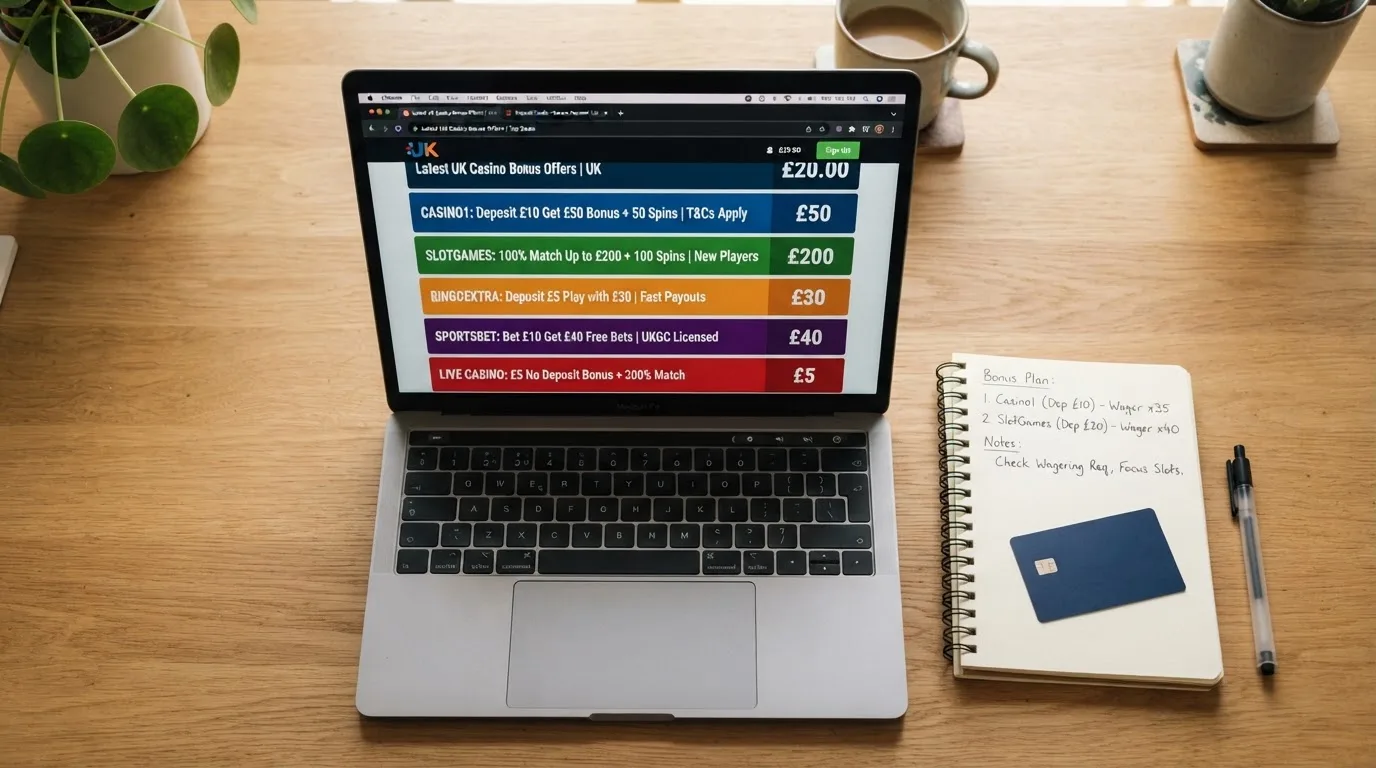
That second step is where most of the cost lives. A 100% match up to £100 with a 35x wagering requirement is not a £100 gift; it is a £3,500 turnover obligation before the bonus balance converts to cash. The 10x cap that took effect on 19 December 2025 changes the shape of this equation materially. An offer that would once have carried a 35x or 40x requirement now has to clear at 10x or below, and that single ceiling is the reason the current UK market looks different from the offshore market a player might see advertised elsewhere.
The bonus balance sits alongside the real-money balance in most UK casino wallets. Real-money funds are spent first on each spin or hand; once they run out, the bonus balance takes over, and only play funded from that balance counts towards the wagering requirement. This sequencing matters because a player who wins early on real-money funds and stops playing has not technically begun the wagering obligation at all.
What the 10x wagering cap actually caps
The cap introduced on 19 December 2025 limits wagering requirements to 10x the bonus amount, the deposit amount, or the combined amount — whichever is lower for the offer in question. Mixed-product bonuses, where a stake on one product (typically sports betting) unlocks a bonus on another (typically casino spins), are banned outright under the same rule set. The Commission framed the change as a consumer protection measure aimed at offers whose playthrough requirements were, in the regulator’s own view, designed to be cleared only by continuing to deposit.

For a player comparing two offers, the cap means the difference between a 10x and a 35x bonus is not a 25-point spread but a roughly threefold difference in the amount of money that has to be risked before a withdrawal becomes possible. The headline percentage match tells a player how big the bonus is; the wagering requirement tells them how big the obligation is. The two are multiplied together to get the actual turnover the player must generate.
Where the bonus stops being worth claiming
The arithmetic of a bonus turns unfavourable when the expected loss from clearing the wagering requirement exceeds the bonus amount. That crossover depends on the Return to Player (RTP) of the games used to clear it. Slots in the UK market typically publish RTPs between 94% and 97%; a 96% slot loses, on average, 4p of every £1 wagered. A £100 bonus at 10x wagering requires £1,000 of slot play, and the expected loss on that play at 96% RTP is £40. The player ends up £60 ahead of where they would have been without the bonus, before accounting for any time spent playing.
The same bonus at the old 35x rate requires £3,500 of slot play, expected loss £140, leaving the player £40 behind. The 10x cap moves the calculation from net-negative at typical RTPs to net-positive. That is the regulatory intent. It also explains why offers with low RTPs, or offers restricted to specific high-house-edge games, are still worth reading carefully even at the capped rate.
Settling deposits and withdrawals at a UK-licensed casino
What payment methods actually work
UK-licensed casinos accept debit cards and bank transfers without restriction. Credit cards have been banned as a funding method for any gambling product since 14 April 2020, including credit cards routed through e-wallets. The Commission’s reasoning, drawn from a 2018 survey, was that around 800,000 UK consumers used credit cards to gamble, and that 22% of online gamblers who funded play with credit cards were classed as problem gamblers.
The practical effect is that the deposit method on a UK casino’s cashier page is almost always a Visa or Mastercard debit card, a bank transfer through the Faster Payments Service, or an e-wallet that has been verified to operate inside UK regulation. Apple Pay became available on UK-issued cards from 14 July 2015 and is supported by most UKGC-licensed casinos that have built a mobile cashier, with tokenisation replacing the card number with a device-specific number and a dynamic security code generated per transaction. AstroPay’s UK entity, Larstal Limited, is an electronic money institution authorised by the Financial Conduct Authority under the Electronic Money Regulations 2011, so an AstroPay deposit at a UK casino routes through an FCA-authorised wallet rather than through an offshore processor.
How long a withdrawal actually takes
UK-licensed operators must run identity, age and source-of-funds checks before the first deposit is accepted, and must run them again before any withdrawal is paid out. The deposit itself, once those checks are complete, moves through the Faster Payments Service for bank-to-bank transfers — launched in 2008 and operated by Pay.UK, running 24 hours a day with most payments arriving instantly or within a couple of minutes, occasionally up to two hours. Faster Payments carries a £1,000,000 per-transaction scheme limit, though individual banks impose their own caps below that.
A withdrawal is a slower process. The operator runs affordability and anti-money-laundering checks against the player’s deposit and play history, and only then releases the funds. The realistic timing, for a player whose account is fully verified at registration, is same-day to three working days for debit card and bank transfer withdrawals; e-wallet withdrawals, where the operator supports them, can be faster once approved. The bottleneck is almost never the payment rail. It is the operator’s internal approval queue and the source-of-funds check that has to clear before funds are released.
Why the ID check happens before the first deposit
Since 7 May 2019 every UK-licensed online gambling operator has had to verify a customer’s name, address and date of birth before accepting a first deposit or any play. The verification is not optional and not deferred. GAMSTOP, the national online self-exclusion scheme, is checked at the same point. A player who has registered with GAMSTOP cannot open an account at any UK-licensed casino for the duration of the self-exclusion period — six months, one year or five years — and the registration cannot be cancelled early. The verification is what makes GAMSTOP enforceable at the account-opening stage.
This is why the crypto shelf and the anonymous-play shelf, addressed later, look the way they do in the UK: a licensed operator cannot offer either, because the regulatory chain breaks at the first deposit.
The landscape of UK-licensed first deposit bonus casinos
The Gambling Commission’s public register held 139 businesses holding an active remote casino operating licence on 18 September 2026, with the register searchable online and downloadable as CSV or Excel files. Each licence number on the register takes the form account-R-number–suffix, where the leading six digits repeat the licence holder’s account number and the “R” marks a remote (online) licence. The register’s domain list records each website against the licence account that runs it, with a status of Active, Inactive or White Label; on 18 September 2026 it held 1,065 active and 361 white-label domain entries — a white-label site trades under another company’s licence, so the same operator may run dozens of brand fronts without holding separate licences for each.
The ten operators reviewed below are taken from that register. The order is the order in which they appear in §6 of the underlying research file and is not a ranking. Several brands share one licensee — Ladbrokes and, separately, the Coral brand sit under LC International Limited — and the comparison table below records the licence holder for each domain so that this consolidation is visible rather than buried.
Comparison: ten UK-licensed first deposit bonus casinos
| Brand | Licence holder and GB remote casino licence | Domain status on the register | Subject support |
|---|---|---|---|
| Unibet | Platinum Gaming Limited, 045322-R-324275-019 | Active | — |
| Betfair | PPB Games Limited, 039411-R-319335-010 | Active | — |
| Sky Vegas | Bonne Terre Gaming Limited, 065519-R-339675-002 | Active | — |
| MrQ | Tek Fox Ltd, 060629-R-337532-004 | Active | — |
| Betway | Betway Limited, 039372-R-319367-029 | Active | — |
| PokerStars | Stars Interactive Limited, 039108-R-319334-026 | Active | — |
| Paddy Power | PPB Games Limited, 039411-R-319335-010 | Active | — |
| Ladbrokes | LC International Limited, 054743-R-330863-014 | Active | — |
| BetVictor | BV Gaming Limited, 039576-R-319370-028 | Active | — |
| Betfred | Petfre (Gibraltar) Limited, 039544-R-319290-010 | Active | — |
The repeated licensee — PPB Games Limited appears behind both Betfair and Paddy Power — is the structural fact this table is built to surface. A player comparing offers across these two brands is, in regulatory terms, comparing two front doors to the same operator. The same consolidation sits behind LC International Limited for Ladbrokes and adjacent brands. Where the licence holder is the same, the responsible gambling code, the deposit limit defaults, and the source-of-funds thresholds are likely to be identical.
The subject-support column carries an em dash for every row, and the reason is direct: the research that backs this page carries no confirmed figure for a first deposit bonus at any of these ten brands. That is not the same as saying these brands do not offer one. It is saying that the research file’s pass on the subject key returned nothing it could attribute to a named source. A player who lands here looking for a current headline number has to check the brand’s own promotional page; this page is the comparison around the licence, not the offer.
The licence line for each reviewed brand
Unibet runs on a Gambling Commission remote casino operating licence held by Platinum Gaming Limited, with unibet.co.uk listed on the public register as an active domain of account 45322. The licence suffix carries forward into any dispute route via the Commission’s ADR process, and Unibet is bound by the GAMSTOP requirement that applies to every online licence issued since 31 March 2020.
Betfair sits on a remote casino licence held by PPB Games Limited (account 39411), with Betfair listed as active on the register. The same account number governs Paddy Power, and the consolidation is what makes the consolidation table above worth reading as more than trivia — a complaint about one flows to the same licence holder as a complaint about the other.
Sky Vegas runs through Bonne Terre Gaming Limited (account 65519), with Sky Vegas listed as active. Sky’s casino product is positioned as the gaming side of a broader Sky entertainment account, and the cashier infrastructure sits behind the same identity verification that governs Sky’s other regulated products.
MrQ is held by Tek Fox Ltd (account 60629), with MrQ listed as active. MrQ positions itself as a no-wagering brand; whether that positioning survives the 10x cap that took effect on 19 December 2025 is a question the brand’s own terms page answers, not this one.
Betway sits on a Betway Limited licence (account 39372), with Betway listed as active. The licence has been renewed across multiple suffixes; the current suffix is the one shown above.
PokerStars runs through Stars Interactive Limited (account 39108), with PokerStars listed as active. The .uk domain is the UK-specific front; the licence account number sits behind the same operator group that runs the broader PokerStars product in other regulated markets.
Paddy Power is on the same PPB Games Limited licence as Betfair, with Paddy Power listed as active. The consolidation repeats the point made under Betfair; a player choosing between the two on bonus terms alone is choosing between two marketing surfaces on one operator.
Ladbrokes runs on LC International Limited’s licence (account 54743), with Ladbrokes listed as active. LC International is the consolidation hub for the broader Ladbrokes Coral group, and several adjacent brand fronts — including Coral — run under the same account number.
BetVictor sits on BV Gaming Limited’s licence (account 39576), with BetVictor listed as active. The licence suffix has rolled forward several times; the current suffix is the operative one for any ADR or complaint escalation.
Betfred runs through Petfre (Gibraltar) Limited (account 39544), with Betfred listed as active. The Gibraltar registration is the corporate seat; the licence that matters for UK players is the Gambling Commission one, and the suffix shown above is the link.
Where the comparison actually decides something
The comparison above answers a narrow question: which of these brands sits on which licence, and whether any of them consolidate under the same operator. It does not answer which one offers the better bonus, because the research does not carry a confirmed figure for any of them, and this page does not invent one. The decision a player makes using this table is between consolidating operators (where the experience across two brands is likely to be near-identical on responsible-gambling defaults, withdrawal timing and dispute routes) and independent operators (where each brand carries its own implementation).
A player with a strong preference for a particular game provider or a particular cashier experience will narrow the field using that preference and then read the licence line to understand who they are actually dealing with. A player who wants only to know which brand is regulated will use the table to confirm that all ten are. The table does not rank; the register does the regulating.
UK gambling law and the licence a first deposit bonus casino must hold
The Gambling Commission is sponsored by the Department for Culture, Media and Sport and operates under the Gambling Act 2005, which covers Great Britain (England, Scotland and Wales) but not Northern Ireland. Since the Gambling (Licensing and Advertising) Act 2014 any operator taking customers in Great Britain needs a Commission licence wherever it is incorporated; a Curaçao, Maltese or Gibraltar corporate seat is not a substitute. A licence number on the public register is the test of whether a brand is licensed to take UK customers. The register can be searched online; the licence number on a casino’s terms page should match the entry on the register for the brand being checked.
The minimum age for any gambling product in Great Britain is 18. The minimum age is enforced at registration: name, address and date of birth are verified before the first deposit or any play, and the date-of-birth check is the gate that keeps under-18s out of the cashier entirely. A casino that takes a deposit without running that check is breaking its licence condition; a player who encounters one should treat it as the reddest of flags.
What the licence obliges an operator to do
A remote casino operating licence carries the Licence Conditions and Codes of Practice (LCCP), the social responsibility code, and the Remote Technical Standards. Three obligations from that package shape the experience of claiming a first deposit bonus:
- The verification chain: identity, age and source-of-funds checks at first deposit and again before withdrawal, with a financial vulnerability check at £150 net deposits in a rolling 30-day window (from 28 February 2025) using public data only.
- The marketing and bonus rules: wagering requirements capped at 10x since 19 December 2025, mixed-product bonuses banned since the same date, and a requirement that operators prompt a customer to set a financial limit before the first deposit (from 31 October 2025).
- The game-cycle rules: a maximum stake of £5 per spin for players aged 25 and over (from 9 April 2025), £2 per spin for 18-24-year-olds (from 21 May 2025), no auto-play since 31 October 2021, a minimum spin interval of 2.5 seconds, and a ban on losses disguised as wins.
A bonus offer that conflicts with any of these rules is not enforceable. A player who has been offered a 35x wagering bonus, or a credit-card-funded bonus, or a bonus that includes a free bet on sport and a casino spin, is looking at an offer that should not be on a UK-licensed site; reporting it through the Commission’s complaint route is one of the more useful things a player can do with that discovery.
What an offshore brand cannot offer
Providing gambling to people in Great Britain without a Commission licence is an offence under section 33 of the Gambling Act 2005. The Commission disrupts illegal sites — through cease-and-desist notices, search-engine delisting, and payment and hosting referrals — but has no power to block sites at ISP level. The penalty does not fall on the player; what the player loses on an unlicensed site is protection. No GAMSTOP, no Commission complaints route, no approved ADR, no source-of-funds framework, no guarantee that a withdrawal request will be honoured. The winnings are unprotected; the data is unprotected; the self-exclusion is unprotected. The bonus terms on an offshore site may look better than anything on a UK-licensed site because the rules the UK imposes on those terms do not apply offshore.
Tax treatment for the player
Players pay no tax on gambling winnings in the UK. Operators pay Remote Gaming Duty, which was raised from 21% to 40% from 1 April 2026 — a model rather than a settled rate, and the actual rate a player sees quoted should be checked with HMRC. The player-side simplicity is the reason a UKGC-licensed casino does not ask for a tax status at withdrawal; the operator-side increase is the reason bonus economics have been tightening across the market.
Responsible gambling around a first deposit bonus
A first deposit bonus is, mechanically, an incentive to deposit more than a player would otherwise deposit. That incentive is the reason the responsible-gambling protections around claiming one are denser than the protections around ordinary play. The same protections apply whether the deposit is funded by a debit card, a bank transfer or cryptocurrency; the licence condition does not vary by funding method.
GAMSTOP and the self-exclusion gate
GAMSTOP is the national online self-exclusion scheme. It is a mandatory condition of every online licence issued since 31 March 2020, which means every UK-licensed online casino must check GAMSTOP at registration. A player registered with GAMSTOP cannot open an account at any UK-licensed site for the duration of their self-exclusion period. The available periods are six months, one year and five years. The registration cannot be cancelled early. The check is what makes the registration enforceable, and the registration is what makes the deposit impossible at the licensed end of the market.
The corollary is that a player who wants to claim a first deposit bonus is, by construction, not currently self-excluded. That is a tautology at the legal level and a useful prompt at the practical one: claiming a bonus is a moment to check whether the deposit you are about to make is one you would still make without the bonus on the table.
Deposit limits and the financial limit prompt
There is no state-set deposit or loss ceiling in the UK; the ceiling is set by the player, with the operator required to prompt the customer to set a financial limit before the first deposit (from 31 October 2025). The prompt is not optional and not deferred; a casino that lets a first-time customer through to the cashier without surfacing a deposit limit is in breach. A player can set a daily, weekly or monthly limit, and a decrease takes effect immediately while an increase usually takes 24 hours or more to apply — a cooling-off structure designed to make raising a limit feel like more friction than lowering one.
The 10x wagering cap (since 19 December 2025) interacts with deposit limits in a way that is worth seeing clearly: a player who sets a £200 monthly deposit limit and claims a 100% match bonus has £400 to play through, of which £200 is bonus balance subject to a 10x turnover requirement (£2,000 of slot play). The deposit limit sets a ceiling on how much can be lost in a month; the wagering requirement sets a floor on how much must be wagered before any bonus winnings become withdrawable. Both numbers belong in the same calculation.
Key responsible gambling limits
| Limit Type | Threshold |
|---|---|
| Financial vulnerability check | £150 net deposits (rolling 30 days) |
| Stake limit (18-24) | £2 per spin |
| Stake limit (25+) | £5 per spin |
| Wagering cap | 10x |
The financial vulnerability check at £150 net deposits in a rolling 30-day window uses public data only. Stake limits apply to slot game cycles, and the 10x wagering cap applies to first deposit bonuses.
The threshold is set low on purpose. £150 net deposits in a month is a small enough figure that most active players will cross it, which means the check fires for the population it is designed to reach. The wider financial risk assessments the Commission has signalled are not yet in force, but the direction of travel is toward more intrusive affordability work, not less.
Help and support
The National Gambling Helpline, run by GamCare, is the main point of contact for a player who feels their gambling is getting away from them. GambleAware funds the broader prevention and treatment infrastructure. Both are independent of any operator. The Commission itself does not run treatment services; it regulates the operators whose customers may need them.
Cryptocurrency and anonymity at a UK first deposit bonus casino
A UK-licensed casino cannot offer anonymous play. The identity, age and source-of-funds verification chain runs before the first deposit regardless of how that deposit is funded, and cryptocurrency is not exempt from the chain. The Gambling Commission’s stance on crypto-funded play at licensed sites is that the operator must still satisfy itself that the funds are legitimate, that the customer is who they say they are, and that the customer is not on the GAMSTOP register.
What crypto funding actually looks like at a licensed site
In practice, a UK-licensed casino that accepts crypto does so through a payment processor that converts the cryptocurrency to fiat before crediting the player’s account. The deposit appears in pounds sterling on the cashier; the player does not hold a BTC balance in the casino wallet. The bonus terms apply to the sterling balance in the same way they apply to a debit-card-funded balance. The wagering requirement, the game restrictions and the time limit are identical. The only thing that varies is the rail the deposit arrived on.
The identity check, however, does not vary. The player is verified at registration in the same way; the source-of-funds check, when it fires at the £150 net deposits threshold, applies to crypto deposits in the same way it applies to debit card deposits. A crypto-funded first deposit does not move a player outside the responsible-gambling framework, and it does not move them outside the verification chain that the framework depends on.
Why the offshore crypto shelf looks different
An offshore casino licensed in Curaçao, Anjouan or a similar jurisdiction can offer a crypto-funded first deposit bonus without running the verification chain the Commission requires. The bonus headline will often be larger; the wagering requirement will often be higher than the UK cap; the time limit will often be tighter; the game weighting will often be skewed toward high-house-edge slots. The reason is simple: the consumer protection rules that compress UK bonus offers do not apply offshore, and the operator is free to set the offer on whatever economics maximise player acquisition rather than player protection.
What the player gives up is the protection. No GAMSTOP, no Commission complaints route, no approved ADR, no source-of-funds framework, no guarantee that a withdrawal request will be honoured. A player who has self-excluded via GAMSTOP can still open an account at an offshore site, because the offshore site is not connected to the GAMSTOP register. A player who has set a deposit limit at a UK site has no equivalent limit at an offshore site. The crypto shelf, in other words, is a regulatory bypass as much as it is a payment method, and the bypass cuts both ways: more bonus on the way in, less recourse on the way out.
Where the 10x cap leaves crypto offers
The 10x wagering cap that took effect on 19 December 2025 applies to bonuses offered to UK customers, regardless of where the operator is licensed, where the player is located, or how the deposit is funded. An offshore operator offering a bonus to a UK customer is bound by the cap if it wants to advertise that bonus into the UK market without risking Commission action. The cap does not, however, prevent an offshore operator from offering a non-UK-targeted bonus at higher wagering terms, and that is the shelf a player sees when they search for “crypto casino first deposit bonus UK” and follow the marketing links.
The honest version of the comparison is that the licensed UK shelf and the offshore crypto shelf are not on the same axis. The licensed shelf is smaller, slower to credit, and capped at 10x wagering. The offshore shelf is larger, faster, and uncapped. The licensed shelf comes with protection; the offshore shelf does not. A player who chooses the offshore shelf is choosing size over protection, and that is a real choice that deserves to be named as such rather than buried in a footnote.
The 10x cap as a band, not a number
The wagering requirement that applies to a first deposit bonus in the UK is, since 19 December 2025, a band rather than a point. The cap is 10x; the floor depends on the operator and the offer. The cost of clearing the bonus is a function of three numbers: the bonus amount, the wagering multiplier, and the RTP of the games used to clear it.
A worked example: a £100 bonus at 10x wagering requires £1,000 of slot play to clear. At 96% RTP, the expected loss on that play is £40. The bonus is worth £60 net of the clearing cost — positive for the player. The same bonus at the old 35x rate would have required £3,500 of slot play, expected loss £140, leaving the player £40 behind. The 10x cap turns the calculation from net-negative to net-positive at typical slot RTPs.
A worked example at the band edge: a £100 bonus at the cap, cleared on a 94% RTP slot, requires £1,000 of play and produces an expected loss of £60. The player breaks even. A £100 bonus at the cap, cleared on a 97% RTP slot, produces an expected loss of £30 and leaves the player £70 ahead. The band is wide enough that the game choice, not just the bonus headline, decides whether the offer is worth taking.
The comparison this band invites is between offers that sit at the 10x ceiling and offers that sit well below it. An offer at 5x wagering on a £100 bonus requires £500 of play and, at 96% RTP, produces an expected loss of £20; the player is £80 ahead. An offer at 10x is good; an offer at 5x is meaningfully better. A player who can choose between offers should weight the wagering multiplier first and the bonus ceiling second.
What the cap does not change
The cap does not change the time limit on the bonus. Most UK bonuses carry a 30-day clearing window from the date of credit; a bonus that is not cleared within that window is forfeited, along with any winnings derived from the bonus balance. The cap does not change the game weighting rules: most slots count 100% towards the wagering requirement, most table games count 10-20%, and a few are excluded entirely. The cap does not change the maximum cashout rule that some offers carry, though many UK offers have moved away from capped cashouts under the same regulatory pressure that produced the wagering cap.
The cap also does not change the difference between a bonus balance and a real-money balance. A player who wins on the bonus balance before clearing the wagering requirement cannot withdraw those winnings; the winnings return to the bonus balance and continue to be subject to the same playthrough. A player who wins on the real-money balance can withdraw those winnings immediately, provided the account has cleared the source-of-funds check. The sequencing matters, and a player who understands the sequencing keeps more of what they win.
Where the calculation stops being arithmetic
The calculation above assumes only the bonus amount is wagered, that the wagering requirement is cleared in full, and that the player has no other play on the account during the clearing window. None of those assumptions hold in practice. A player who deposits additional funds during the clearing window is mixing real-money and bonus play in ways the calculation does not model. A player who fails to clear the requirement inside the time limit forfeits the bonus and any winnings derived from it. A player who plays a mix of games at different RTPs sees a blended house edge that sits between the worst and best case.
The calculation is a statistical estimate — an average over many spins under the stated assumptions — not a guaranteed outcome for any single player. It tells a player what to expect across a large number of clearing attempts. It does not tell a player what will happen on the next spin, or the next hundred, or the next session. A player who treats the calculation as a forecast for their own play is using it in a way it does not support; a player who treats it as a way to compare two offers is using it the way it is meant to be used.
A closing note on what this page does and does not do
This page is a comparison of ten UK-licensed casinos around the licence they hold, the registration they carry on the Gambling Commission’s public register, and the responsible-gambling framework that licence obliges them to operate inside. It is also a worked-through explanation of what a first deposit bonus costs a UK player under the 10x wagering cap that took effect on 19 December 2025, and what that cap changes about the comparison a player is making.
This page does not rank the ten brands. The research that backs it does not carry a confirmed figure for a first deposit bonus at any of them, and this page does not invent one. A player who lands here looking for the current headline offer at a particular brand has to check the brand’s own promotional page; this page is the comparison around the licence, the responsible-gambling framework and the cap, not the offer.
This page also does not recommend a brand to a player as a place to play. A recommendation is the wrong shape for a comparison page; what a comparison page gives the reader is the framework for making their own choice. The framework here is: every brand in the table is licensed, several share a licensee and therefore a responsible-gambling implementation, the bonus economics are bounded by the 10x cap regardless of the brand, and the offshore shelf is a different market with a different rule set and a different protection profile. The player takes it from there.
Frequently asked questions about first deposit bonuses at UK casinos
How is a first deposit bonus usually calculated?
A first deposit bonus is a percentage match on the first payment a new customer makes. A 100% match up to £100 means a £100 deposit credits a £100 bonus; a 50% match up to £200 means a £200 deposit credits a £100 bonus. The bonus sits as a separate balance and is converted to withdrawable cash once the wagering requirement is cleared. Since 19 December 2025 the wagering requirement is capped at 10x the bonus, the deposit or the combined amount.
Can a first deposit bonus be funded with cryptocurrency?
At a UK-licensed casino, yes — but the verification chain is the same. The deposit is converted to sterling before it is credited; the bonus terms apply to the sterling balance in the usual way. At an offshore casino, cryptocurrency can fund a bonus without the UK verification chain, but without GAMSTOP, without the ADR route and without the source-of-funds framework that a UKGC licence provides.
Does a first deposit bonus require identity verification before it pays out?
Yes. Identity, age and source-of-funds verification has been required before the first deposit at every UK-licensed online casino since 7 May 2019. The verification includes a GAMSTOP check. A player who is registered with GAMSTOP cannot open an account at any UK-licensed site for the duration of the self-exclusion period. The verification runs before the deposit, not after.
What wagering usually applies to a first deposit bonus in the UK?
Since 19 December 2025 the wagering requirement is capped at 10x. The cap applies to the bonus amount, the deposit amount or the combined amount — whichever produces the lower figure. Mixed-product bonuses (such as a sports bet that unlocks casino spins) are banned under the same rule set. The cap is enforced by the Gambling Commission across every UK-licensed online casino.
Is a first deposit bonus separate from a no-deposit bonus?
Yes. A no-deposit bonus is credited without a deposit, typically as a small number of free spins or a fixed cash amount, and carries its own wagering requirement. A first deposit bonus requires a deposit to unlock and is typically larger. A player can sometimes claim both in sequence at the same casino, but the wagering requirements are tracked separately and the time limits are usually distinct.
How long is a first deposit bonus usually valid for once credited?
Most UK-licensed casinos give a 30-day window from the date of credit to clear the wagering requirement. A bonus that is not cleared inside the window is forfeited, along with any winnings derived from the bonus balance. The exact window varies by brand and by offer, and is set out in the bonus terms before the deposit is made; a player who plans to clear a bonus over weeks rather than days should check the window before claiming.