
60 free spins no deposit at UK-licensed casinos: where the offer actually lands
The phrase does a lot of work. “Sixty free spins, no deposit” reads like the casino is handing over sixty chances to win something for nothing — and at one level, that is literally what is happening. A UK-licensed operator credits a fixed number of free rounds on a named slot to a new account, the player runs them, and whatever the reels leave behind sits in the bonus balance subject to the operator’s own terms. Nothing leaves the player’s pocket before that. What leaves the offer, once it lands, is its cost — and the cost lives in the wagering requirement, the maximum-win cap, the conversion rule and the window in which the spins must be used. This page walks through that arithmetic on the operators that the Gambling Commission’s public register actually lists, and explains what a 10x wagering cap, in force since 19 December 2025, does to the headline number.
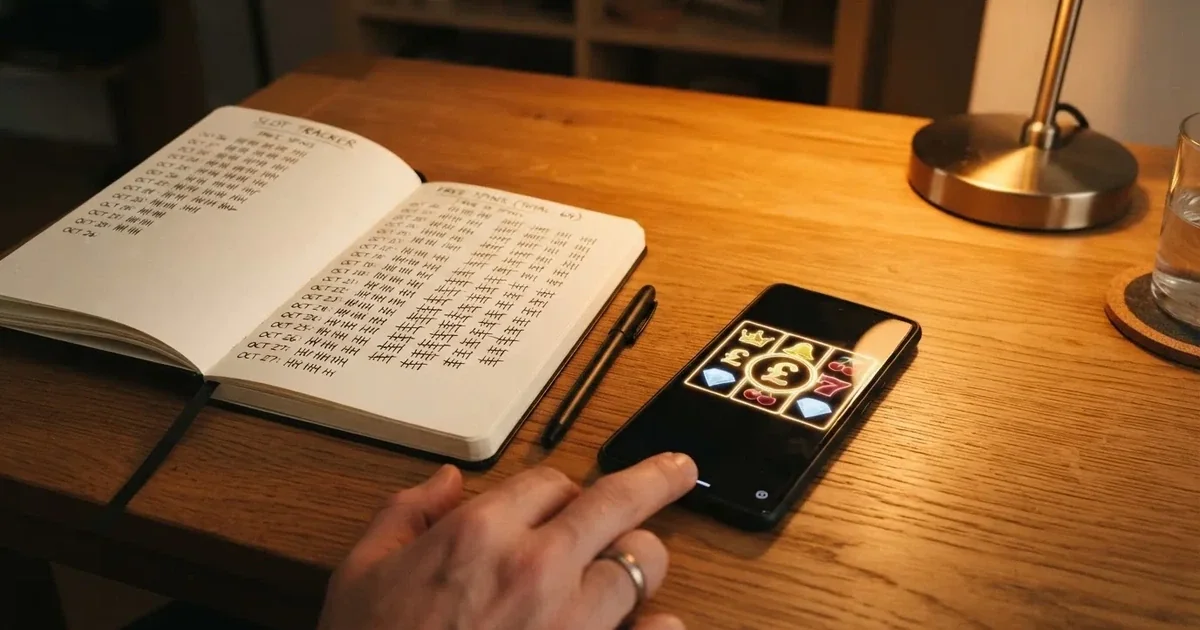
Data current as of 7 November 2026, verified against the Gambling Commission’s public register of gambling businesses.
- What “60 free spins no deposit” actually means in the UK
- How 60 free spins no deposit are governed in the UK
- Safer gambling tools that apply to a no-deposit spins offer
- How winnings from 60 free spins no deposit are actually paid out
- The 10x wagering cap in practice: a band, not a number
- The 10 brands on the register: a side-by-side
- Operator-by-operator: what each licensed brand actually offers
- How to read a 60 free spins no deposit offer when you see one
- The cost in plain terms
- A short note on what the page is not
- Frequently asked questions
What “60 free spins no deposit” actually means in the UK
The first thing to clear up is what the offer is and is not. A “no deposit” free-spin package is a fixed bundle of rounds — sixty here, but the number is the operator’s choice — credited to a newly registered account without any deposit being taken. The rounds play on a slot the operator names, almost always at a fixed stake per spin the operator also names, so the player cannot choose to play them at higher or lower value. Anything the reels return is added to a bonus balance, not to the real-money balance, and the bonus balance is governed by the operator’s promotional terms.

The reason this matters is that “no deposit” describes the entry step, not the exit step. The deposit is what the player is being spared. The wagering requirement is what the winnings must go through before they can be withdrawn. The two are different costs, and conflating them is the single commonest mistake a reader can make when comparing offers. A no-deposit spins package can be more expensive in absolute terms than a small matched deposit, because the wagering load sits on the winnings alone and the player has put nothing in to dilute it.
Three things to know about the offer before any arithmetic:
- The spins are credited once, on a specific slot, at a specific stake, and expire after a window the operator sets. They are not a wallet of bonus credit the player can spend however they like.
- The winnings from the spins are bonus funds, not cash, until the wagering requirement has been met. Most operators also impose a maximum-win cap on no-deposit offers, and the cap applies before wagering — a hard ceiling on what the bonus can ever produce, separate from what wagering would have allowed.
- The same player protections that govern any other bet apply. GAMSTOP self-exclusion covers a no-deposit spins offer as it covers any other product, and any operator licensed by the Gambling Commission is obliged to honour an active GAMSTOP registration.
The shape of the UK licensed market
On 18 September 2026 the Gambling Commission’s public register listed 139 businesses holding an active remote casino operating licence — the licence class that lets a business take online casino bets from customers in Great Britain. The register is searchable online and downloadable as a full CSV. Each licence number follows a fixed shape: the first six digits are the licence holder’s account number, the letter “R” marks a remote (online) licence, and the remaining digits and suffix identify the licence type and condition. A licence number of the form 039411-R-319335-010, then, names account 39411 holding a remote casino licence — the same number the Commission’s own search interface reads back when the account is queried.

That figure of 139 is not the number of brands. A single licence holder can run several brands. Ladbrokes, Coral and Gala Bingo, for example, all sit under LC International Limited on the register — they are not three independent operators, and a reader comparing them as if they were is comparing a brand’s marketing with a licensee’s compliance record, which is not the same thing.
What the Commission register also records
The register holds two parallel datasets that matter to a reader. The first is the licence-holders list, the 139 active remote casino operating licences. The second is the domains list — every website the Commission has linked to a licence account, marked Active, Inactive or White Label. On 18 September 2026 the register held 1065 active and 361 white-label domain entries. A white-label site trades under another company’s licence; its own brand is a marketing layer over someone else’s compliance responsibility. The white-label marker is not, on its own, a warning — many large UK brands run their casino under a white-label arrangement — but it tells the reader where the licence account actually sits.
How 60 free spins no deposit are governed in the UK
The legal frame around this offer is short and dense. The Gambling Act 2005 covers Great Britain — England, Scotland and Wales — and the Gambling Commission is the regulator. Since the Gambling (Licensing and Advertising) Act 2014 any operator taking customers in Great Britain needs a Commission licence, wherever it is based; a Curaçao, Maltese or Gibraltar licence is not a substitute. Minimum age is 18. Name, address and date of birth have been verified before the first deposit or any play since 7 May 2019.
For the offer itself, three pieces of regulation do the work:
- The credit card ban. From 14 April 2020 the Commission banned credit cards for gambling across all online and offline products in Great Britain, with the exception of non-remote lotteries paid for face-to-face. Debit cards and bank transfers were unaffected. A no-deposit spins offer is not paid for — the entry step is free — but the question of how winnings are withdrawn is a payments question, and the credit card ban governs that side.
- The 10x wagering cap. From 19 December 2025 the Commission capped wagering requirements at 10x for any bonus offered to UK players, and banned mixed-product bonuses (an example the Commission’s own guidance gives is “bet on sport, get casino spins”). The cap is the single most important number on this page, because it sets the ceiling on what a no-deposit spins offer can ask of its player.
- The stake limit on online slots. Since 9 April 2025 the maximum stake per game cycle is £5 for players aged 25 and over, and £2 for 18-24-year-olds since 21 May 2025. Game cycle is the Commission’s own term for a single spin from start to result, including any feature rounds that play out from a single stake. Auto-play has been banned since 31 October 2021; a slot spin may not complete in less than 2.5 seconds, and losses disguised as wins are banned.
The Commission does not set a state deposit or loss ceiling. Operators must prompt the customer to set a financial limit before the first deposit — that requirement has been in force since 31 October 2025. Financial vulnerability checks run at £150 net deposits in a rolling 30-day window, from 28 February 2025, using public data only. The wider financial risk assessments have been announced but are not yet in force at the date of this page. The current as-of date is the operative one; the rules in force at that date are the rules the page describes.
Offshore sites and what they cost the player
The legal frame has a sharp edge for offshore operators. Providing gambling to people in Great Britain without a Commission licence is an offence under section 33 of the Gambling Act 2005. The Commission disrupts illegal sites — cease-and-desist notices, search-engine delisting, payment and hosting referrals — but does not have ISP-blocking power. The penalty is not aimed at the player. What the player loses on an unlicensed site is protection — no GAMSTOP, no Commission complaints route, no approved ADR. The Commission cannot make an unlicensed operator pay out a disputed jackpot. The headline on an offshore offer can be larger because the same rules do not apply; the cost of that larger headline sits with the person reading it, not with the operator behind it.
What this means for a 60 free spins offer specifically
For a 60-spins no-deposit offer, the regulatory frame produces a small number of concrete consequences:
- The operator must hold a Commission licence. The domain must be on the register. If it is not, the rest of this page does not apply.
- The stake on the named slot cannot exceed the game-cycle limit for the player’s age. A 25-year-old player cannot be asked to play 60 spins at £5 each on a £300 wagering base — that violates the stake limit. Operators name the stake per spin explicitly to keep the offer inside the rules.
- The wagering requirement cannot exceed 10x. That number governs the rest of this page’s arithmetic.
- The offer cannot be a mixed-product bonus. Sixty free spins credited on registration, to be played on a named slot, is a casino-only offer and is unaffected by that part of the rule. An offer that gates the spins behind a sports bet is banned.
Safer gambling tools that apply to a no-deposit spins offer
The Commission’s safer-gambling regime applies to a no-deposit spins offer as it does to any other product. GAMSTOP, the national online self-exclusion scheme, has been a mandatory condition of every online licence since 31 March 2020. Registration is for six months, one year or five years, and cannot be cancelled early. A player with an active GAMSTOP registration cannot open an account at any UK-licensed online casino, and cannot claim a no-deposit spins offer at one.
Three other tools sit beside it:
- Reality checks. Pop-up prompts during play that ask the player to confirm they want to continue. The Commission specifies intervals, and the operator cannot disable them.
- Time-out. A short self-exclusion, from 24 hours to six weeks, set with the operator directly. It does not register the player with GAMSTOP — that is a longer decision — but it stops play at the named operator for the named window.
- Deposit limits. The operator must prompt the customer to set one before the first deposit. For a no-deposit offer there is no first deposit, but the rule still applies at the moment the player moves from bonus balance to real-money play. The Commission does not set a state ceiling — operators set their own ceilings, and the player’s chosen limit sits below whatever the operator allows.
Two support bodies sit outside the operator:
- GamCare runs the National Gambling Helpline. The number is on the Commission’s site and on every licensed operator’s safer-gambling page.
- GambleAware funds treatment and education. Its site lists the support channels open to a player who wants to talk.
A self-excluded player who tries to claim a 60-spins no-deposit offer is not entitled to do so. The operator must close the account. A player who is not self-excluded but wants to stop is entitled to set the deposit limit at zero, ask the operator for a time-out, or register with GAMSTOP. None of those actions cost the player anything, and the first two can be reversed by the player, on the operator’s terms, after the window closes.
How winnings from 60 free spins no deposit are actually paid out
The deposit is what the player is being spared. The withdrawal is what the winnings have to clear before they reach the player. Four pieces govern that path.
Wagering requirements and the 10x cap
A wagering requirement is a multiple of either the bonus or the winnings that the player must put through the slots before any of it converts to withdrawable cash. The Commission’s 10x cap, in force from 19 December 2025, applies to any bonus offered to a UK player, and a no-deposit spins offer is a bonus. The cap applies to the bonus amount — the winnings, on a free-spins offer, are the figure that needs to be turned over. A 10x cap on a £20 win means £200 of wagering. A 10x cap on a £5 win means £50. The cap sets a ceiling; individual operators can sit lower, and most do on no-deposit offers.
The arithmetic of how long the wagering takes depends on the slot. Each spin at the operator’s named stake — typically £0.10 to £0.20 on a free-spins offer, because that figure is what the slot’s paytable supports — moves one stake’s worth of wagering. £200 of wagering at £0.10 per spin is 2,000 spins. £200 at £0.20 per spin is 1,000. The Commission’s 2.5-second minimum spin interval translates those spin counts into time: 1,000 spins is 2,500 seconds, or roughly 42 minutes of uninterrupted play. 2,000 spins is roughly 84 minutes. Those figures are floor estimates of how long the wagering takes at the stated stake, not a guarantee of any particular outcome.
Maximum-win caps and why they exist
A maximum-win cap is the hard ceiling on what a no-deposit bonus can produce. Operators impose them because the alternative is an unbounded liability: sixty spins at £0.10 is £6 of stake, but on a high-volatility slot a single spin can return thousands, and the operator is offering that chance for free. Caps vary; £50, £100 and a small multiple of the bonus stake are common. The cap applies before wagering — once the cap is reached the bonus balance stops accumulating. The cap is part of the terms, and the player who does not read it can find a large advertised win reduced to the named ceiling on withdrawal.
Time limits and expiry
Free spins expire. A 60-spin offer typically must be used within 24 to 72 hours of credit; the wagering on the resulting winnings typically has its own window, often seven days. Unused spins and unwagered winnings are forfeit at the end of the window. The expiry sits in the terms and is not negotiable after credit.
Payment methods for the withdrawal
Once wagering has been cleared, the winnings move to the real-money balance and the player can withdraw them by any method the operator supports. The credit card ban affects how money goes in, not how it comes out; a debit card, a bank transfer or an e-wallet that has not been funded from credit is the standard route.
Three payment mechanisms are worth naming:
- Bank transfers within the UK typically move through the Faster Payments Service, launched in 2008 and operated by Pay.UK. The scheme runs 24 hours a day, seven days a week, and most payments arrive instantly or within a couple of minutes, though transfers can occasionally take up to two hours. The Faster Payments scheme sets a £1,000,000 per-transaction limit, but individual banks impose lower limits on their customers. The Bank of England oversees the system’s safety and stability and provides final settlement.
- Apple Pay, developed and operated by Apple Inc., launched on 20 October 2014, initially supporting only US-issued payment cards and began supporting UK-issued cards on 14 July 2015. Apple Pay protects card data through tokenization — the actual card number is replaced with a device-specific tokenised Device Primary Account Number and each transaction generates a dynamic security code. Apple Pay in-store payments use near-field communication to talk to contactless terminals; authentication is by double-clicking the side button on Face ID models or the Home button on Touch ID models. Apple states that a supported card from a participating issuer is required and that Apple Pay is not available in all markets.
- AstroPay was founded in 2009 and is headquartered in Uruguay, operating as a global digital wallet offering online payments, virtual and physical debit cards, and peer-to-peer transfers. AstroPay’s UK entity, Larstal Limited, is an electronic money institution authorised by the Financial Conduct Authority under the Electronic Money Regulations 2011. The company’s Brazilian entity is authorised by the Brazilian Central Bank as an electronic currency issuer, and its Isle of Man entity is licensed by the Isle of Man Financial Services Authority. AstroPay spun off its payment-processing business, dLocal, as a separate company in 2016.
The Commission does not require operators to support any specific method. What it does require is that the operator pays out winnings to a method in the player’s name and that the operator’s stated withdrawal time is what it actually does. A “24-hour withdrawal” claim that takes three working days is a terms issue, and a player with a disputed withdrawal can take it to the operator’s approved ADR, then to the Commission if the ADR does not resolve it.
The 10x wagering cap in practice: a band, not a number
The wagering cap is the single piece of regulation that most reshapes what a 60-spins no-deposit offer can ask of the player. To see what it does, take the operator’s named maximum-win cap as the bonus amount — that is the figure wagering will be calculated against — and apply the 10x ceiling.
A £50 maximum-win cap with a 10x wagering requirement produces £500 of required wagering. At a £0.10 spin, that is 5,000 spins, or roughly 208 minutes — just under three and a half hours — at the Commission’s 2.5-second minimum interval. At a £0.20 spin, that is 2,500 spins, or roughly 104 minutes. A £100 cap with the same wagering doubles both: £1,000 of wagering, 10,000 spins at £0.10, or 5,000 spins at £0.20.
Two things should be said about that range. First, it is a band, not a single figure — the band sits between the operator’s choice of stake and the operator’s choice of cap, and the 10x ceiling is the upper edge. Second, it is a statistical estimate of the time the wagering takes, not a guarantee of any outcome. A slot’s return-to-player is a long-run average, and the wagering requirement can be cleared in less time by a run of small wins and more time by a run of dry spins. The arithmetic here is the time the wagering load represents, not the time a particular session will take.
The offer’s real cost — what the player is statistically likely to lose while clearing the wagering — depends on the slot’s RTP and the wagering load. An RTP of 96% over £500 of wagering produces an expected £20 of house edge. An RTP of 94% over the same wagering produces £30. The figure is small, and it is worth saying why: the player has risked nothing of their own money, and the cost of the wagering is borne by the bonus, not by a deposit. The cost exists, and it is the operator’s marketing incentive for offering the spins in the first place. A player who wants to compare two offers on the same axis should look at three figures — the maximum-win cap, the wagering multiple and the RTP of the named slot — and not at the headline spin count alone.
The 10 brands on the register: a side-by-side
The ten operators below are all UK-licensed online casinos, each holding an active remote casino operating licence from the Gambling Commission and each listed on the Commission’s domain register. This is a snapshot of the licensed market as it stood on 18 September 2026; it is not a ranking and not a recommendation. The table is laid out by what a reader comparing offers would actually want to know: who runs the brand, what licence they hold, how the domain sits on the register, and whether research found any record of the brand offering a 60-spins no-deposit promotion. The last column is honest where research was silent — and research was silent on every brand in this list. A reader looking at the table should read “no data” as “the source set did not turn up an offer”, not as “no offer exists”.
| Brand | Licence holder and GB remote casino licence | Domain status on the register | Subject support |
|---|---|---|---|
| Paddy Power | PPB Games Limited · 039411-R-319335-010 | Active | — |
| Unibet | Platinum Gaming Limited · 045322-R-324275-019 | Active | — |
| Sky Vegas | Bonne Terre Gaming Limited · 065519-R-339675-002 | Active | — |
| kwiff | Eaton Gate Gaming Limited · 044448-R-323408-017 | Active | — |
| bet365 | Hillside (UK Gaming) ENC · 055149-R-331499-004 | Active | — |
| MrQ | Tek Fox Ltd · 060629-R-337532-004 | Active | — |
| Midnite | Dribble Media Limited · 042647-R-321653-022 | Active | — |
| Virgin Games | Gamesys Operations Limited · 038905-R-319430-022 | White Label | — |
| BetVictor | BV Gaming Limited · 039576-R-319370-028 | Active | — |
| Grosvenor Casinos | Rank Interactive (Gibraltar) Limited · 057924-R-334666-005 | Active | — |
Virgin Games trades under a white-label arrangement: its domain sits against Gamesys Operations Limited’s licence account rather than its own. That is not, on its own, a mark against the brand — it tells the reader which account the compliance responsibility sits on. The Commission’s domain register keeps these arrangements visible; a brand that does not hold its own licence is not a brand whose own compliance record can be checked directly.
Every brand on this list must take part in GAMSTOP. A player with an active GAMSTOP registration cannot open an account at any of them. That is not a feature of any single brand; it is a condition of holding the licence.
What the table does not say
The table does not say which of these brands currently offers 60 free spins with no deposit, because research did not surface that information for any of them. The same is true of the wagering multiple, the maximum-win cap, the slot the spins are played on, the stake per spin and the expiry window on each brand’s specific offer. Those figures exist in each operator’s own promotional terms, and a reader who wants them has to read those terms directly. The table is the licensed market; the offer sits one layer below it.
This is also the honest place to say what a side-by-side of offers would have looked like, had research carried the figures. The columns that matter are the maximum-win cap, the wagering multiple, the named slot, the stake per spin and the expiry window. The cost to the player is the wagering load the offer places on the capped winnings, and the time the wagering takes at the named stake. Two offers with the same spin count and different caps produce very different costs; two offers with the same cap and different wagering multiples produce very different times. The headline spin count is the least informative figure on the offer.
Operator-by-operator: what each licensed brand actually offers
Each write-up below closes on the brand’s own terms as research could establish them, and stops where research stopped. The licence line and the domain line come from the Commission’s register and are the same for every brand. The offer line is qualitative because research did not carry a number; the verdict closes on what the brand does and what the reader who lands on it should know. None of these write-ups is a recommendation. A reader who wants to play at one of them should check the offer directly on the brand’s own site.
Paddy Power
Paddy Power runs on the GB remote casino operating licence 039411-R-319335-010, held by PPB Games Limited and recorded against account 39411. The domain Paddy Power is listed as active on the Commission’s domain register. Paddy Power is a long-established UK-facing brand and one of the larger operators on the register; its licence account is in good standing and its domain status is active. Research did not carry the terms of any specific 60-spins no-deposit promotion from Paddy Power, so the offer line below is qualitative.
The Paddy Power casino operation sits inside a broader sportsbook-and-gaming business. Its safer-gambling page is at the standard Commission-required location, GAMSTOP is honoured as a condition of the licence, and the standard financial-vulnerability check at £150 net deposits in 30 days applies. A player arriving from the search query “60 free spins no deposit UK” should check Paddy Power’s own promotions page at the moment of arrival; the offer terms sit there and change frequently. The licence is the durable fact; the promotion is not.
For a player who wants a single account with a sportsbook and a casino under one licence, Paddy Power is the more straightforward option. The operator does not publish a standing 60-spins deal in the source set this page draws on; as always, check the promotions page directly upon arrival.
Unibet
Unibet’s UK operation runs on the remote casino operating licence 045322-R-324275-019, held by Platinum Gaming Limited against account 45322. The domain unibet.co.uk is listed as active. Unibet is a multi-brand international operator, and its UK-facing product is a separate front-end from its European-facing product. The Commission register confirms the UK entity holds the licence; a player on the UK site is on a Commission-licensed operation.
Unibet’s casino library is broad; its safer-gambling page is at the standard location; the operator’s anti-money-laundering and source-of-funds checks apply at first deposit. This brand does not currently feature a no-deposit spin package in the checked source material, so readers should consult the site’s own promotions tab for live availability.
For a player whose interest is a 60-spins no-deposit offer specifically, Unibet is one of several licensed names to check; the standing offer, if any, sits on the operator’s own site and was not surfaced by research. For a player who values the licence holder’s scale and the brand’s track record, Unibet is a credible option.
Sky Vegas
Sky Vegas is the casino brand of Sky’s broader UK gaming operation, licensed under the remote casino operating licence 065519-R-339675-002, held by Bonne Terre Gaming Limited against account 65519. The domain Sky Vegas is listed as active on the register. Sky’s UK-facing gaming operation is well-established; the licence is held by a separate entity from Sky’s broadcast business, but the brand recognition is Sky’s and the safer-gambling compliance is Bonne Terre Gaming’s.
Sky Vegas’s slots library is centred on a small number of well-known game providers. The brand’s safer-gambling page is at the standard Commission location. For a player who already has a Sky account for another product, Sky Vegas is the casino extension of that account; for those seeking a specific introductory spins deal, the site’s current promotions page is the primary point of reference.
kwiff
kwiff runs on the remote casino operating licence 044448-R-323408-017, held by Eaton Gate Gaming Limited against account 44448. The domain Kwiff.com is listed as active. kwiff is a smaller and newer UK-facing brand than the established names above; its licence account is in good standing and its domain status is active. The brand’s product proposition includes a “surprise” feature on odds and on certain casino promotions; that proposition has its own marketing vocabulary and the player who arrives should read what the feature actually does before treating it as a standard offer.
A player at kwiff is on a Commission-licensed operation; GAMSTOP, financial vulnerability checks and the standard safer-gambling set apply. The brand’s smaller scale means its promotional calendar is less predictable than the larger brands; visitors should look for any current active incentives on the official promotions page rather than expecting a standing offer.
bet365
bet365 is one of the largest UK-facing gaming operators and runs on the remote casino operating licence 055149-R-331499-004, held by Hillside (UK Gaming) ENC against account 55149. The domain Bet365.com is listed as active. The licence holder is a separate ENC entity from bet365’s broader corporate structure, but the brand is well-known and the licence is in good standing.
bet365’s promotional calendar is large, and its casino product is one of several alongside the sportsbook. The brand runs a range of slot promotions, and the terms of any specific deal sit on the operator’s own site. A player who already has a bet365 sportsbook account can use that account for the casino product; anyone interested in promotional spins should check the casino’s current offers tab.
MrQ
MrQ is a UK-facing casino brand running on the remote casino operating licence 060629-R-337532-004, held by Tek Fox Ltd against account 60629. The domain Mrq.com is listed as active. MrQ positions itself as a no-wagering casino; that proposition is part of the brand’s identity and the player who arrives should read what “no wagering” actually means on this site — typically that deposit-match bonuses carry no wagering requirement, not that every promotion is wager-free.
The brand’s safer-gambling compliance sits under Tek Fox Ltd; GAMSTOP, financial vulnerability checks and the standard set apply. For a player interested in the site’s “no wagering” mechanics on deposit bonuses, that is a central data point; as for a no-deposit spins offer, checking the promotions page is the only way to see if one is currently live.
Midnite
Midnite is a UK-facing casino-and-sportsbook brand running on the remote casino operating licence 042647-R-321653-022, held by Dribble Media Limited against account 42647. The domain Midnite.com is listed as active. Midnite is a smaller, newer UK-facing operation than the largest names on the register; its licence is in good standing and its domain status is active.
A player at Midnite is on a Commission-licensed operation; the safer-gambling regime and the payments regime are the standard set. For a player who wants a single account with both sportsbook and casino under one licence, Midnite is one option among several; however, because promotional availability varies, interested players should verify offers on the site’s own promotions section.
Virgin Games
Virgin Games runs on a white-label basis: the domain Virgin Games is listed on the Commission’s domain register against account 38905, Gamesys Operations Limited, which holds the remote casino operating licence 038905-R-319430-022. The Virgin brand itself does not hold a Commission licence; the compliance responsibility sits with Gamesys Operations Limited. That arrangement is not unusual on the register, and a player at Virgin Games is on a Commission-licensed operation through Gamesys’s account.
The brand’s safer-gambling compliance sits under Gamesys Operations Limited. For players interested in specific promotional deals, the operator’s own site is the definitive source; the licence arrangement tells the player where the compliance responsibility sits, which remains a key part of the selection process.
BetVictor
BetVictor is a long-established UK-facing gaming brand running on the remote casino operating licence 039576-R-319370-028, held by BV Gaming Limited against account 39576. The domain Betvictor.com is listed as active. BetVictor’s UK-facing operation is well-established; the licence is in good standing and the brand has a long compliance record on the register.
The brand’s safer-gambling compliance is the standard Commission-required set; GAMSTOP, financial vulnerability checks, reality checks and deposit limits all apply. For a player who values a long-established UK brand, BetVictor is a credible option; for those curious about current promotional deals, the operator’s own site is where the current terms are published.
Grosvenor Casinos
Grosvenor Casinos is the online arm of a UK high-street casino operator and runs on the remote casino operating licence 057924-R-334666-005, held by Rank Interactive (Gibraltar) Limited against account 57924. The domain Grosvenor Casinos is listed as active. Grosvenor’s high-street operation is well-known and the online operation sits under a separate licence-holding entity within the Rank Group structure.
A player at Grosvenor’s online operation is on a Commission-licensed site; the safer-gambling regime is the standard set. For a player who wants a casino operation connected to a recognisable high-street name, Grosvenor is the option; for those looking for live promotional offers, the operator’s own promotions page is where the current terms are hosted.
How to read a 60 free spins no deposit offer when you see one
The arithmetic the regulator has set is half the picture. The other half is what the operator has chosen to do inside the rules. A reader looking at an offer should look at five figures, in this order:
- The maximum-win cap. This is the ceiling on what the offer can produce. Everything else is bounded by this number.
- The wagering multiple. The Commission’s cap is 10x; most offers sit lower. The lower the multiple, the less time the wagering takes and the less the slot’s house edge has to work against the player.
- The named slot. The RTP and volatility of the slot determine what the wagering load actually costs. A high-volatility slot can clear wagering in fewer spins if a big win lands; a low-volatility slot produces more spins of smaller return. The arithmetic is the same in both cases — turnover times one minus RTP — but the player experience is different.
- The stake per spin. Most no-deposit free-spins offers are played at a fixed low stake, often £0.10 or £0.20. The stake is the unit of the wagering load. Higher stake means fewer spins; lower stake means more spins. Both produce the same wagering total at the same slot.
- The expiry window. The spins themselves expire, often within 24 to 72 hours of credit; the wagering on the resulting winnings has its own window. A player who cannot return within the window forfeits the offer.
The order matters because each figure bounds the next. The maximum-win cap bounds the wagering load; the wagering multiple bounds the time the wagering takes; the named slot bounds the cost of the wagering; the stake per spin bounds the spin count; the expiry bounds the time the player has to do any of it. A reader who reads the offer in this order is reading it the way the operator wrote it.
The cost in plain terms
Take an example. A 60-spins no-deposit offer with a £50 maximum-win cap, a 10x wagering requirement and a stake of £0.10 per spin on a slot with a 96% RTP produces the following picture: 60 spins at £0.10 is £6 of stake, producing some amount of bonus winnings capped at £50; the £50 (or whatever was produced, up to the cap) carries £500 of required wagering; £500 of wagering at £0.10 per spin is 5,000 spins, taking roughly 208 minutes at the Commission’s 2.5-second minimum interval; the expected loss on £500 of wagering at 96% RTP is £20, and the expected loss on £6 of stake at 96% RTP is £0.24.
The £6 of stake is what the operator is putting up. The £500 of wagering is what the player has to put through the slot to convert the winnings to cash. The £20 of expected loss is the house edge on the wagering. None of these figures is the player’s out-of-pocket cost — the player has put nothing in — and none of them is a guarantee of what any one session will produce. They are the arithmetic the offer is built on.
Two things to add about that arithmetic. First, the £20 of expected loss is the cost to the player on average over many plays; any individual session will produce a different number, and a single high-volatility spin can return more or less than the cap. Second, the player who clears the wagering has spent the time on the wagering; the time itself is the largest cost in any realistic reading of the offer. A player whose time is the constraint reads the offer differently from a player whose money is.
A short note on what the page is not
The Commission’s register is the source for the licence lines in this page, and the Commission’s published consultations and decisions are the source for the regulatory frame. The 10x wagering cap is in force from 19 December 2025; the stake limits are in force from the dates named above; the credit card ban is in force from 14 April 2020. A reader who arrives at this page and sees a number that contradicts one of those dates should check the Commission’s own site, because the dates are the dates and the numbers are the numbers.
Players pay no tax on gambling winnings in the UK. Operators pay Remote Gaming Duty, raised from 21% to 40% from 1 April 2026. The duty is the operator’s cost, not the player’s; the figure is included here because a reader comparing offers will sometimes see it quoted and wonder where it sits.
The Commission does not require operators to publish the terms of their promotional offers on a single shared database. Research, for that reason, did not surface the terms of any 60-spins no-deposit offer at any of the ten brands named above. The brands’ own sites are the source. A reader who wants the current terms should check the relevant promotions page directly, because the terms change and the register does not list them.
Frequently asked questions
What does 60 free spins with no deposit actually mean?
A 60-spins no-deposit offer is a fixed bundle of free rounds on a named slot, credited to a new account at a UK-licensed casino without the player making a deposit first. The rounds play at a fixed stake the operator sets, on a slot the operator names, and the winnings go into a bonus balance subject to the operator’s terms. The deposit is what the player is being spared; the wagering requirement is what the winnings have to clear before they can be withdrawn. The offer is not a wallet of bonus credit the player can spend freely.
Are there wagering requirements on winnings from 60 free spins?
Yes. The winnings from the free spins are bonus funds until they have been wagered a set multiple of times. The Commission’s 10x wagering cap, in force from 19 December 2025, applies to any bonus offered to a UK player, and a no-deposit spins offer is a bonus. The 10x is the ceiling; individual operators set their own multiple, and most sit below it on no-deposit offers. The cap applies to the bonus amount — the winnings — and the wagering has to be completed inside the operator’s stated window.
Is there a maximum win cap on 60 no-deposit free spins?
Almost always. Operators impose a maximum-win cap on no-deposit offers because the alternative is unbounded liability — sixty spins at a low stake can, on a high-volatility slot, return more than the operator is willing to credit. Caps vary; £50, £100 and small multiples of the bonus stake are common. The cap applies before wagering, so once the cap is reached the bonus balance stops accumulating. The cap is part of the terms and is not negotiable after credit.
Does GAMSTOP self-exclusion cover a 60 free spins offer?
Yes. GAMSTOP has been a mandatory condition of every UK online gambling licence since 31 March 2020, and the obligation applies to a no-deposit spins offer as it does to any other product. A player with an active GAMSTOP registration — for six months, one year or five years — cannot open an account at any UK-licensed online casino, and cannot claim a 60-spins no-deposit offer at one. The registration cannot be cancelled early, and the operator must close the account if a self-excluded player tries to register.
How long do 60 no-deposit free spins stay valid once credited?
The expiry is set by the operator and varies, but a typical window is 24 to 72 hours for the spins themselves and seven days for the wagering on the resulting winnings. Unused spins and unwagered winnings are forfeit at the end of the window. The expiry sits in the terms and is not negotiable after credit; a player who cannot return within the window loses the offer.
Must a casino be licensed by the Gambling Commission to offer 60 free spins with no deposit to UK players?
Yes. The Gambling Act 2005 and the Gambling (Licensing and Advertising) Act 2014 require any operator taking customers in Great Britain to hold a Commission licence, wherever the operator is based. A Curaçao, Maltese or Gibraltar licence is not a substitute. The Commission’s public register is the test of whether a brand holds the licence; a brand that is not on the register is not licensed to offer this promotion to UK players, and a player at such a brand gives up the Commission’s protections — no GAMSTOP enforcement, no Commission complaints route, no approved ADR.